by Goldschmidt Conference
Originally published by EurekAlert
26 June 2016
New research shows that most of the radioactive fallout which landed on downtown Tokyo a few days after the Fukushima accident was concentrated and deposited in non-soluble glass microparticles, as a type of ‘glassy soot’. This meant that most of the radioactive material was not dissolved in rain and running water, and probably stayed in the environment until removed by direct washing or physical removal. The particles also concentrated the radioactive caesium (Cs), meaning that in some cases dose effects of the fallout are still unclear. These results are announced at the Goldschmidt geochemistry conference in Yokohama, Japan. Continue reading Most radioactive caesium fallout on Tokyo from Fukushima accident was concentrated in glass microparticles→
The purpose of this post is to present measurements of artificial radionuclides in wild Atlantic salmon (Salmo salar) made in 1990’s and reported in a peer reviewed paper published in the Canadian Journal of Fisheries and Aquatic Sciences by Tucker and colleagues in 1999. This post is part of an ongoing series dedicated to communicating the results of scientific research aimed at The paper combines an understanding of bioconcentration of the artificial radionuclide 137-cesium (137Cs half life ~30 years) in marine food webs with quality measurements of the contaminant in salmon that spent their lives in the North Atlantic Ocean. The North Atlantic at the time had a strong east to west gradient in 137Cs concentrations in seawater with >10 Bq m-3 in the east owing to spent nuclear fuel reprocessing in Europe and the recent impact of the Chernobyl disaster and <1.5 Bq m-3 in the west near to Canada. Salmon returning to the Ste. Marguerite River in Canada had a wide range of radiocesium in their bodies which reflected the entire range of values seen in fish harvested across the Atlantic Ocean. The results indicate that the migration routes of these salmon extended all the way across the Atlantic to the Irish and Norwegian seas. The study is relevant to understanding the impact of the Fukushima disaster on radiocesium levels in Pacific salmon as the maximum levels of contamination of seawater we see in the central and eastern North Pacific is lower than the maximum levels studies by Tucker and colleagues. Given this fact we would predict that levels of Fukushima derived contaminants in Pacific salmon and the health risk associated with the consumption of these fish will be correspondingly lower. Thus far the salmon monitoring results from the Integrated Fukushima Ocean Radionuclide Monitoring (InFORM) project are in keeping with the scientific communities understanding of 137Cs bioconcentration in fish outlined in the Tucker study and references therein.
Radionuclides in Atlantic Salmon: Bioconcentration and migration routes
When I was an undergraduate student at McGill University in Montreal, Dr. Joe Rasmussen (he is now at the University of Lethbridge in Alberta) headed up a freshwater ecology group that used radionuclides to understand energy and contaminant cycling in the aquatic environment. I remember learning about gamma spectrometry and the processing of samples for radionuclide determinations through conversations with his graduate students. Their work made an impression on me and highlighted the utility of radioisotopes for understanding rates of processes and pathways of contaminant transport in natural waters. The paper I will summarize here roughly dates to my time at McGill and is the work of Strahan Tucker who along with Marc Trudel works for Fisheries and Oceans Canada at the Pacific Biological Station in Nanaimo BC and part of the team of scientists working on the InFORM project. Tucker and colleagues exploited the east to west gradient in 137Cs activity in seawater in the North Atlantic to determine how much radiocesium was present in Atlantic salmon returning to the Ste. Marguerite River in Canada and by extension where they had migrated and fed during their growth and development. The figure below shows the high levels of seawater 137Cs contamination in the Irish Sea and eastern Atlantic compared to the western Atlantic near Canada owing to release of the isotope from fuel reprocessing plants in the UK and France and deposit of Chernobyl derived contamination in 1986.
137Cs distribution (Bq m–3) in waters of the North Atlantic with levels >10 in marginal seas of the eastern Atlantic and 0-1.5 in waters of the west near to Canada.
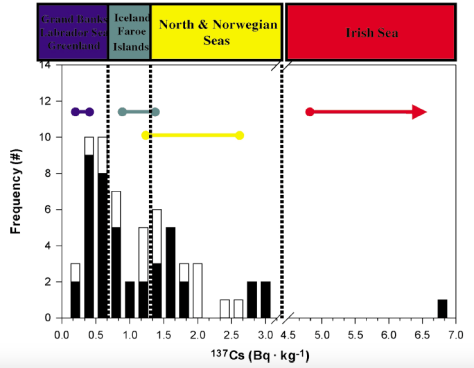
Given that salmon tend to bioconcentrate radiocesium about 130 times relative to the seawater in which the live (through the prey they consume) the predicted range in 137Cs in salmon from the eastern Atlantic would be 1.3 — 4.0 Bq kg-1 while fish living in the less contaminated western Atlantic would have 0.15 — 0.65 Bq kg-1. The range of 137Cs measured by Tucker and colleagues in salmon returning to the St. Marguerite River in Quebec, Canada, predicted ranges given seawater activities in the figure above and activities in fish harvested from different areas of the North Atlantic are summarized in the figure below.
Frequency distribution of 137Cs concentrations (Bq kg–1) in Atlantic salmon from the Ste. Marguerite River, Que. Tissue samples were obtained fish caught in the sport fishery during the summers of 1995 (n = 33) and 1996 (n = 28) and measured by gamma spectrometry. Dashed vertical lines denote the expected range in 137Cs concentrations in salmon based on a mean bioaccumulation factor of 130 from waters in the North Atlantic outlined in the color bar above (water 137Cs concentrations color coded as in the first figure). Horizontal lines denote the observed ranges in 137Cs concentrations in salmon and other fish (cod, whiting, haddock, hake, mackerel, and plaice) caught in those same waters.
The range of activities found in the migratory Atlantic salmon is similar to the range seen for other species of fish across the North Atlantic and suggests that almost half of the Ste. Marguerite salmon spent their lives feeding in waters near to Norway and the UK. This is an amazing result and suggested that more fish spend more time in the eastern Atlantic than was thought at the time. The levels seen in the salmon agree well with predictions based on seawater activities and the expected bioconcentration factor in the food web to salmon of ~130. You can read more about bioconcentration of radionuclides and concentration factors in marine organisms in one of my earlier posts here.
What does this tell us about expected contamination from Fukushima in Pacific Salmon and health risks to consumers?
The maximum seawater concentration of 137Cs in the central and eastern North Pacific we have measured through the InFORM project is about 7 — 10 Bq m-3. Given the bioconcentration expected from previous studies of salmonid species like Tucker and colleagues above we might expect maximum contamination levels in Pacific salmon of ~ 1.3 Bq kg-1 wet weight. The range of values we have detected in Pacific species returning to British Columbia rivers and streams since the Fukushima disaster in 2011 is ~0.20-0.60 Bq kg-1 suggesting that these fish have consumed prey and lived in waters with seawater activities <10 Bq m-3. At present the levels of Fukushima derived contamination do not lead to ionizing radiation doses to consumers that remotely approach the dose attributable to naturally occurring radioisotopes like 40K and 210Po. The ionizing radiation dose from the naturally occurring isotopes do not approach levels where significant risks to the health of consumers are to be expected. Given what the scientific community understands about bioconcentration of the most radiologically significant isotopes released from Fukushima and measured and forecast levels of these isotopes in the expansive North Pacific the community has confidence that levels in Pacific salmon species will not approach levels were risk to consumers will become significant. The InFORM project will continue to monitor contamination levels in seawater and the marine biota to provide accurate information and useful, scientifically derived assessment of risk to the public.
Fisherman from the “Kiyomaru” fishing boat pull in their net as they sail off the Iwaki town south of crippled Daiichi nuclear power plant, Fukushima prefecture September 20, 2013. Only a small part of the boat’s catch will be used to test for radioactive contamination in the waters near the Fukushima Daiichi nuclear facility, while the rest will be thrown back into the ocean. (REUTERS/Damir Sagolj)
March 11 will mark the five-year anniversary of the Fukushima Daiichi disaster, a series of nuclear meltdowns, triggered by a devastating earthquake-induced tsunami, that released massive amounts of radioactive material and resulted in the largest nuclear disaster since Chernobyl. Since then, the plant’s damaged drainage system has continued to leak radioactive water into the environment, and one of the biggest enduring public concerns has been the safety of fish caught in the area’s surrounding waters.
Miro is a trained truffle dog that belongs to Simon Egli, a co-author of the Biogeosciences paper based at Swiss Federal Research Institute WSL. He’s pictured here with a Burgundy truffle he found in Switzerland. Credit: Simon Egli, WSL
by European Geosciences Union EurekAlert
Published 25 Feb 2016
Some forest mushrooms, such as wild porcini, can accumulate dangerous levels of radioactivity from the soils they grow in. But until now it was unclear if the same was true for truffles, fungi that range among the most expensive foods in the world. Swiss and German researchers have analysed Burgundy truffles collected in central Europe and found they contain only negligible amounts of radioactive caesium, being safe for consumption. The results are published today (25 February) in Biogeosciences, an open access journal of the European Geosciences Union (EGU).
Shells of sea snails (Thais clavigera); one of the organisms missing from near the Fukushima Dai-ichi Nuclear Power Plant
The purpose of this post is to report on a newly published, peer-reviewed study in the open access journal Scientific Reports that uses field observations to determine how intertidal species abundance and diversity were affected by the 2011 earthquake, tsunami and Fukushima Dai-ichi Nuclear Power Plant (FDNPP) disaster. This post is part of an ongoing series dedicated to summarizing the results of scientific studies aimed at understanding the impact of the FDNPP disaster on ecosystem and public health. Horiguchi and colleagues surveyed intertidal marine organisms and made measurements of artificial radionuclides in specimens in 2011, 2012 and 2013. They found that in 2012 the number of intertidal organisms was lower closer to the FDNPP than farther away and that the sea snail (Thais clavigera) was absent from sampling locations <30 km from the FDNPP. Because sea snails were found in other rocky habitats affected by the tsunami in 2011 the absence of these organisms in 2012 near the plant might be related to the FDNPP disaster. In 2013 both the numbers of organisms and diversity of species were found to be lower at sites within several kilometers south of the FDNPP site. While, according to the authors, there is no clear explanation for the findings at present it is clear that the intertidal biota has been impacted close to the FDNPP since the disaster. The authors conclude that:
it is unlikely that the tsunami was solely responsible for changes in the intertidal communities given the distribution of sea snails
other causes might include acute or sub-acute toxicities from the largest leaks from the FDNPP site in March-April 2011 containing artificial radionuclides, boric acid and hydrazine (and other chemicals)
most significant impacts to the intertidal community occurred along the coast south and proximal to FDNPP which likely reflects predominant local water currents
The changes noted by Horiguchi and colleagues in the intertidal community contrast with the lack of significant changes in benthic organisms along the Japanese coast by Sohtome and colleagues that was summarized here.

 by Goldschmidt Conference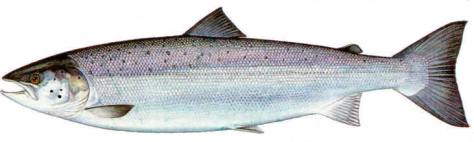



 Home
Home 