Tag Archives: 134-Cs

Residents Living South of the Fukushima Dai-ichi Have Minimal Internal Radiation Exposure

Areas to the south of the Fukushima Daiichi nuclear power plant. WBC measurement were performed at the Jyoban Hospital in central Iwaki, which is located about 50 km south of the Fukushima Daiichi nuclear power plant. Study subjects were mainly hospital visitors from Iwaki and its suburbs.

By Jay T. Cullen

The purpose of this post is to relate findings published (open access) in the peer-reviewed journal PLOSOne by Akiyama and colleagues who investigated internal radiocesium contamination in residents living south of the Fukushima Dai-ichi Nuclear Power Plant. This post is the most recent in a series dedicated to sharing the results of scientific research into the impact of the nuclear power plant disaster on ecosystem and public health. The Akiyama study builds on recent work by this group using a whole body counter (WBC) to look for internal contamination of residents living near (north and west) the reactors at the time of the meltdowns. Measurements were made on 9,206 affected individuals, including 6,446 school children (4-15 years) living south of the reactors or evacuated to Iwaki city following the bulk of radionuclide releases. Measurements began one year after the accident and continued for two years. The authors conclude that, despite lack of data for the first year following the disaster, internal doses experienced by residents to the south of the FNPP were minimal. This suggests that efforts to mitigate foodborne exposure have been largely successful and that nearly all the annual effective doses for this segment of the population more than one year after the disaster are likely due to external exposure. Continue reading Residents Living South of the Fukushima Dai-ichi Have Minimal Internal Radiation Exposure

Fukushima Derived Contamination of Whales and Dolphins in Northern Japan

By Jay T. Cullen

Pacific white sided dolphins (Photo from the Nakamura et al. (2015) study published in MEPS)


The purpose of this post is to report on a recently published, peer-reviewed study documenting the contamination of whales and dolphins in northern Japan following the Fukushima Dai-ichi Nuclear Power Plant disaster in March 2011. This post is the most recent in an ongoing series that documents scientific research into the impacts of the FDNPP disaster on the health of the marine environment. The paper by Nakamura and colleagues investigated the levels of artificial radionuclides 134Cs (half life ~ 2 years) and 137Cs (half life ~30 years) and naturally occurring 40K (half life 1.25 x 10⁹ years) in stranded whales and dolphins in 2011 and 2012 following the disaster. While there was little radiocesium present in the seawater around the northern island of Hokkaido after the disaster some of the animals had detectable levels of radiocesium from the FDNPP in the months following the disaster. By 2012 most stranded animals did not have detectable levels of FDNPP derived radiocesium. According to the authors, the sudden rise in radiocesium levels in the animals following the disaster suggests that the contamination in the animals reflected the seawater activities of the radionuclides through which they swam north rather than bioconcentration through the marine food web. Levels of artificial radionuclides were about 10-fold lower than naturally occurring isotopes in the organisms and are not likely to be causing negative health impacts but may be useful for helping to better understand the migration routes of these animals. Continue reading Fukushima Derived Contamination of Whales and Dolphins in Northern Japan

Update: Sampling for Fukushima Derived Radionuclides in the Northeast Pacific and Arctic 2015

By Jay T. Cullen

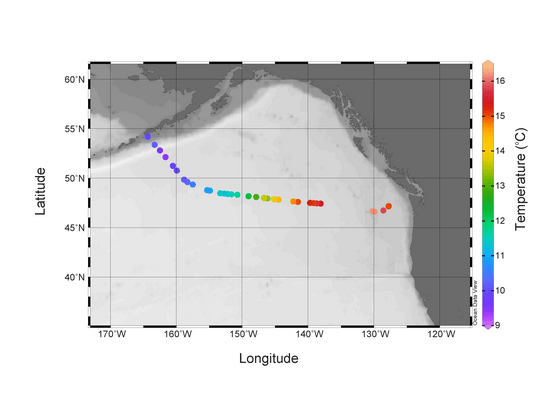
Locations where surface seawater samples were collected for the InFORM project in July 2015. Surface seawater temperatures at the time of collection are shown with values greater than 16C in the anomalous region referred to colloquially as “the blob”.


The purpose of this short post is to update readers on the activities of the Integrated Fukushima Ocean Radionuclide Monitoring (InFORM) project. This post is the most recent in a series documenting scientific research into the impact of the Fukushima Dai-ichi disaster on environmental and public health. Surface seawater samples were collected from the icebreaker CCGS Sir Wilfrid Laurier as it traveled between Victoria BC to Dutch Harbor Alaska during July 2015. These seawater samples will be analyzed to characterize the distribution of Fukushima derived radionuclides 137-Cesium (137Cs half life ~30 years), and 134-Cesium (134Cs half life ~2 years). As in previous years this information will help to determine how well model predictions of the activities and progression of ocean borne contamination across the Pacific Ocean match with observations. Understanding the spread of this contamination provides important information on the impact of the Fukushima Dai-ichi disaster on the health of the Pacific ecosystem and the North American public. The evolution of the contaminant plume in time and space also helps the scientific community to better understand ocean mixing which is a key parameter toward understanding the oceans role in mitigating atmospheric greenhouse gas increases and climate change.
Continue reading Update: Sampling for Fukushima Derived Radionuclides in the Northeast Pacific and Arctic 2015

Radioactive Strontium and Cesium in Fish From the Harbor at the Fukushima Dai-ichi Nuclear Plant

By Jay T. Cullen

The purpose of this post is to report on a recent peer-reviewed study that investigated the radionuclide content of fish caught in the harbor of the Fukushima Dai-ichi Nuclear Powerplant (FDNPP) in 2012 and 2013. The post is also written in part to address questions like:

Why don’t you measure 90Sr in fish you catch off of North America?

This post is part of an ongoing series dedicated to summarizing results from scientific research into the impact of the FDNPP disaster on the environment. Fujimoto and colleagues measured the activity of Cesium-134 (134Cs half life ~2 years), Cesium-137 (137Cs half life ~30 years) and Strontium-90 (90Sr half life ~29 years) in fish collected from the FDNPP harbor and just outside the port in 2012 and 2013. Fish were most contaminated in the harbor and had radiocesium activity concentrations (in whole body without internal organs, Bq kg-1 – wet weight) that were ~200-330 times higher than measured 90Sr levels. The much lower 90Sr levels compared to radiocesium in the fish is consistent with much lower releases of 90Sr to the Pacific Ocean compared to radiocesium in the aftermath of the meltdowns at FDNPP (see here, here and here for example). The activity of radiocesium in fish diminishes dramatically with distance from the harbor and as of April-June 2015 none of the fish caught in Fukushima prefecture waters exceeded the stringent 100 Bq kg-1 Japanese safety standard. Across the Pacific, we have yet to detect Fukushima derived radiocesium in salmon and steelhead trout caught in British Columbian waters as part of the Fukushima InFORM monitoring effort. 90Sr is much more difficult and costly to analyze in environmental samples than are the cesium isotopes. The results of the Fujimoto study suggest that 90Sr from Fukushima is unlikely to be found at detectable levels in marine organisms in the northeast Pacific and that resources to monitor the impact of the disaster on our marine environment should focus on the detection of the cesium isotopes. Continue reading Radioactive Strontium and Cesium in Fish From the Harbor at the Fukushima Dai-ichi Nuclear Plant

July 2015 InFORMal Monitoring Update

July 2015 CS update-web-01
InFORMal monitoring results for water samples collected in April/May 2015

Results* from April citizen science monitoring are now available from 8 of 11 (above: bold italics) of the current InFORM sampling locations. Additionally, two samples from May are available from Ucluelet and Port Renfrew. The Ucluelet sample was collected by the Ucluelet Aquarium for our partner organization, Our Radioactive Ocean, on May 7th and did contain trace amounts (0.5 Bq m-3) of the Fukushima fingerprint, 134Cs, with it’s short ~2 year half life.  The total level of activity from this sample is roughly half the activity of the February sample, which was the last time 134Cs was detected on the BC coast.   Continue reading July 2015 InFORMal Monitoring Update