All posts by fukushimainform

Radioactive Strontium and Cesium in Fish From the Harbor at the Fukushima Dai-ichi Nuclear Plant

By Jay T. Cullen

The purpose of this post is to report on a recent peer-reviewed study that investigated the radionuclide content of fish caught in the harbor of the Fukushima Dai-ichi Nuclear Powerplant (FDNPP) in 2012 and 2013. The post is also written in part to address questions like:

Why don’t you measure 90Sr in fish you catch off of North America?

This post is part of an ongoing series dedicated to summarizing results from scientific research into the impact of the FDNPP disaster on the environment. Fujimoto and colleagues measured the activity of Cesium-134 (134Cs half life ~2 years), Cesium-137 (137Cs half life ~30 years) and Strontium-90 (90Sr half life ~29 years) in fish collected from the FDNPP harbor and just outside the port in 2012 and 2013. Fish were most contaminated in the harbor and had radiocesium activity concentrations (in whole body without internal organs, Bq kg-1 – wet weight) that were ~200-330 times higher than measured 90Sr levels. The much lower 90Sr levels compared to radiocesium in the fish is consistent with much lower releases of 90Sr to the Pacific Ocean compared to radiocesium in the aftermath of the meltdowns at FDNPP (see here, here and here for example). The activity of radiocesium in fish diminishes dramatically with distance from the harbor and as of April-June 2015 none of the fish caught in Fukushima prefecture waters exceeded the stringent 100 Bq kg-1 Japanese safety standard. Across the Pacific, we have yet to detect Fukushima derived radiocesium in salmon and steelhead trout caught in British Columbian waters as part of the Fukushima InFORM monitoring effort. 90Sr is much more difficult and costly to analyze in environmental samples than are the cesium isotopes. The results of the Fujimoto study suggest that 90Sr from Fukushima is unlikely to be found at detectable levels in marine organisms in the northeast Pacific and that resources to monitor the impact of the disaster on our marine environment should focus on the detection of the cesium isotopes. Continue reading Radioactive Strontium and Cesium in Fish From the Harbor at the Fukushima Dai-ichi Nuclear Plant

Background Ionizing Radiation Dose Through Geologic Time

By Jay T. Cullen

The purpose of this post is to review how the background dose of ionizing radiation has changed through geologic time until the present. I was motivated to write this by questions and misinformed statements made to me regarding the likelihood that the low levels of ionizing radiation now added to the Pacific Ocean might harm marine microbes and effectively kill the base of the oceanic food chain – given levels being measured this is for all intents and purposes impossible. This post is part of an ongoing series that summarizes the results of scientific research into the impact of the Fukushima Dai-ichi nuclear disaster on the health of the marine environment and residents of the west coast of North America. Life on Earth has been exposed to ionizing radiation since the first organisms began leaving chemical signs of their existence almost 4 billion years ago. In a paper published in 1999 Karam and Leslie calculated how the dose experienced by organisms from naturally radioactive geological and biological materials has changed over time. They find that overall the annual beta and gamma dose experienced by organisms has dropped from about 7 millisievert (mSv = 0.001 Sv) 4 billion years ago to about 1.4 mSv today. Given the similarity of repair mechanisms that organisms use to cope with damage from ionizing radiation it is likely that these mechanisms evolved early in Earth’s history which may explain why organisms are capable of dealing with higher than background doses in the environment today. Continue reading Background Ionizing Radiation Dose Through Geologic Time

Collection of the July 2015 Citizen Science Sample in Prince Rupert

Prince Rupert BC

Prince Rupert’s July 2015 sample was recently collected by our volunteer team at Northwest Community College including visiting science teacher Sandy Humphrey from SD 91. Sampling is being coordinated by Cheryl Paavola (Instructor and Science Lab Tech) at Northwest Community College – Prince Rupert.

Sandy Humphrey of SD 91 collecting the InFORM seawater sample in a very sunny Prince Rupert harbour.
Sandy Humphrey and Cheryl Paavola at Prince Rupert.
The sample will be processed and analyzed for radiocesium and naturally occurring radionuclides.

Continue reading Collection of the July 2015 Citizen Science Sample in Prince Rupert

Sampling for Fukushima Derived Radionuclides in the Northeast Pacific and Arctic 2015

By Jay T. Cullen

Bow of the CCGS Laurier. Great ship and crew for science operations in the Arctic.
The purpose of this short post is to update readers on the activities of the Integrated Fukushima Ocean Radionuclide Monitoring (InFORM) project. This post is the most recent in a series documenting scientific research into the impact of the Fukushima Dai-ichi disaster on environmental and public health. Today the icebreaker CCGS Sir Wilfrid Laurier will leave Victoria BC bound for Dutch Harbor Alaska and then up through Bering Sea and Strait to the Arctic Ocean. On the way the InFORM project will collect surface seawater to characterize the distribution of Fukushima derived radionuclides 137-Cesium (137Cs half life ~30 years), and 134-Cesium (134Cs half life ~2 years). As in previous years this information will help to determine how well model predictions of the activities and progression of ocean borne contamination across the Pacific Ocean match with observations. This provides important information on the impact of this contamination on the health of the Pacific ecosystem and the North American public that rely on the ocean for their food, livelihood and recreation. The evolution of the contaminant plume in time and space also helps the scientific community to better understand ocean mixing which is a key parameter toward understanding the oceans role in mitigating atmospheric greenhouse gas increases and climate change. Continue reading Sampling for Fukushima Derived Radionuclides in the Northeast Pacific and Arctic 2015

Update: Monitoring Results For Sockeye Salmon and Steelhead Trout Collected Summer 2014

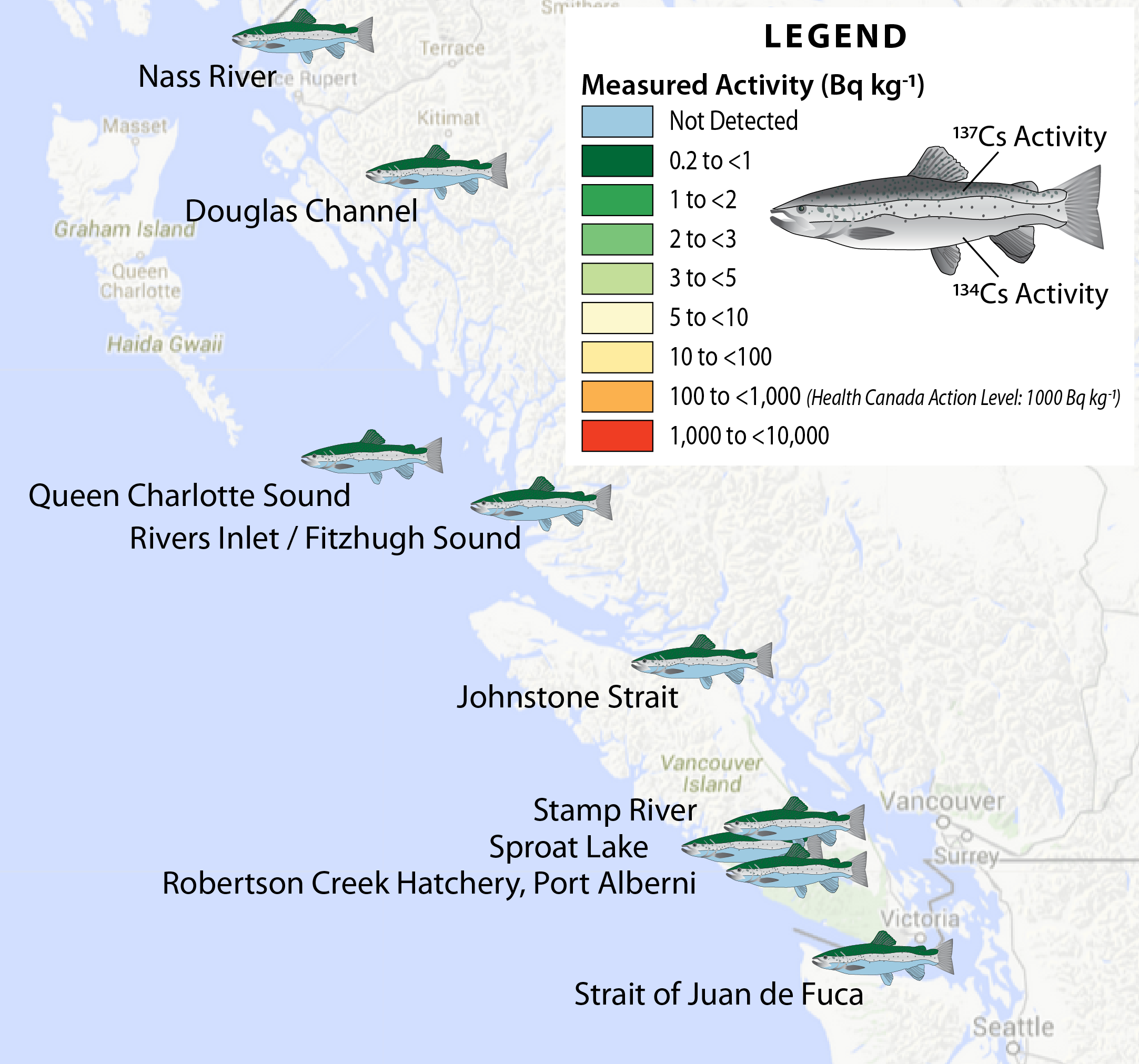
Summary of the amount of radioactive cesium isotopes in sockeye salmon and steel head trout harvested from BC waters in 2014 (Figure by Jonathan Kellogg jkellogg@uvic.ca).

The measurements undertaken as part of the InFORM project to look for Fukushima derived radionculides in fish during our first of three years of monitoring are now complete. Sockeye salmon (Oncorhynchus nerka) and Steelhead Trout (Oncorhynchus mykiss) (as well as some Chinook, Chum and Pink Salmon) were caught off the west coast of Canada in Summer 2014 as they were returning to 9 different streams and rivers up and down the coast of British Columbia Canada. These results add to the first 19 fish which we reported on in December of 2014.

Continue reading Update: Monitoring Results For Sockeye Salmon and Steelhead Trout Collected Summer 2014