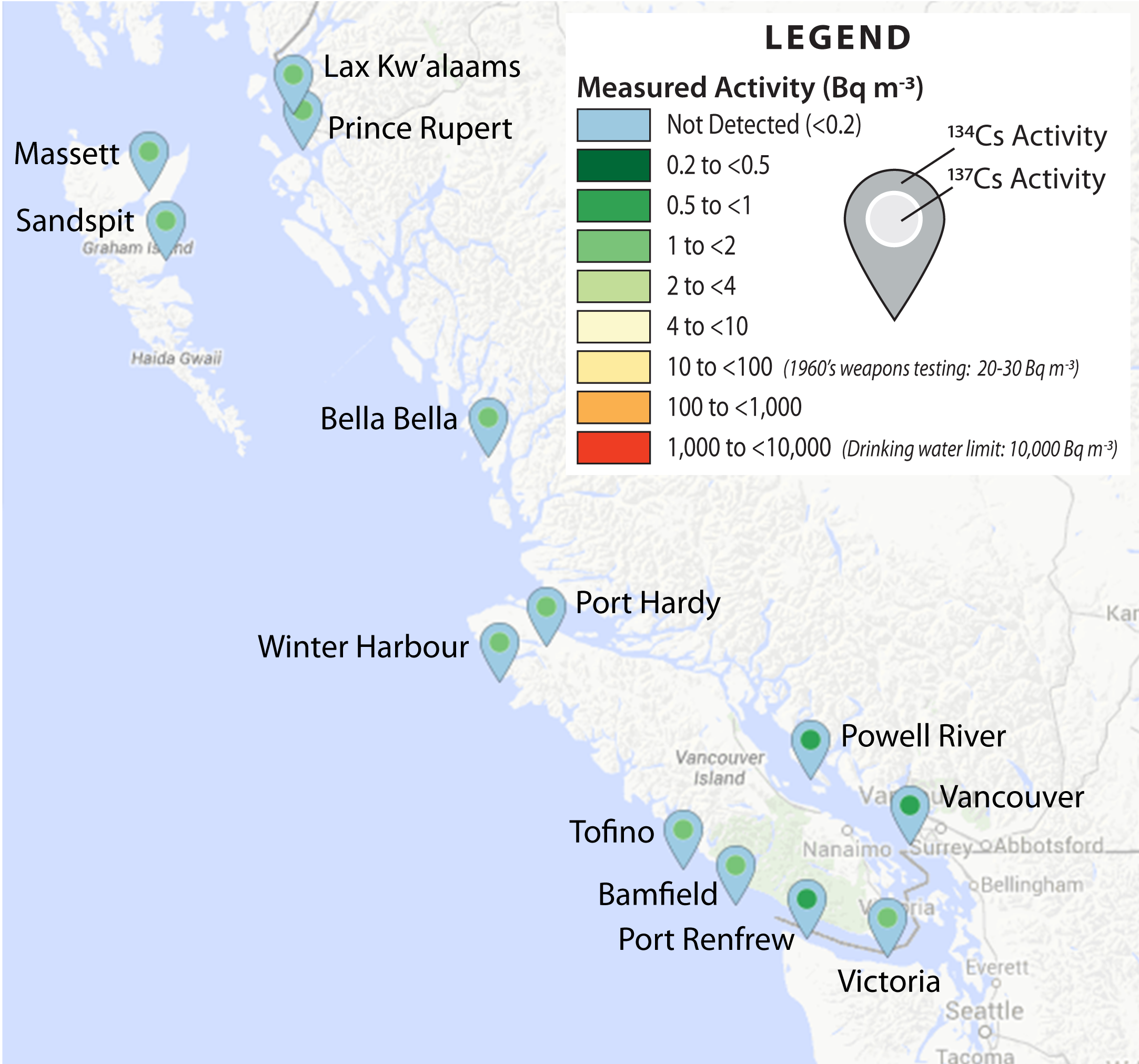
Forty water samples have been collected between October 2014 and March 2015 from 13 communities along the British Columbia coast. Results* from 19 samples are currently available.

Forty water samples have been collected between October 2014 and March 2015 from 13 communities along the British Columbia coast. Results* from 19 samples are currently available.
Feb. 19, 2015
Prince Rupert BC
Prince Rupert’s third sample was recently collected by our volunteer team including students from NWCC Desiree Louis (College and Career Prep program) and Michael Standbridge (Applied Coastal Ecology (ACE) program). Sampling is being coordinated by Cheryl Paavola (Instructor and Science Lab Tech) at Northwest Community College – Prince Rupert.
Continue reading Prince Rupert Citizen Science Monitoring Continues for February 2015
@JayTCullen and @FukushimaInFORM
February 16, 2015
What we found:
The absence of any detectable 134-Cs (an unambiguous fingerprint isotope of Fukushima contamination) in the seawater samples indicates that as of November 2014 these locations covering the length of the British Columbia coast have not be affected by ocean currents carrying Fukushima contamination.
The detection limit for 134-Cs averages ~0.2 Bq m-3
Newly added results come from seawater samples collected in collaboration with citizen scientists at the following locations in British Columbia, Canada during November 2014.
Samples were processed and the amount of gamma emitting isotopes determined using a high purity germanium detector. We look primarily for radioisotopes of cesium (134-Cs half life ~2 years and 137-Cs half life ~ 30 years) for the following reasons:
The absence of detectable 134-Cs indicates that waters near these locations spanning the length of British Columbia have not been contaminated with Fukushima radioactive elements transported across the Pacific by prevailing currents as of Nov 2014. The presence of 137-Cs is due to historical sources of this human made isotope owing to atmospheric nuclear weapons tests in the 20th century and contamination from the Chernobyl disaster in 1986. You can read about the levels of 137-Cs in the North Pacific pre-Fukushima here.
More results will be published as they become available.
Cullen Lab: Chemical Oceanography
 January 28, 2015
Cullen traveled to Halifax to present a talk about the early stages of the InFORM project and efforts to build a citizen scientist network and mobilize knowledge about the impacts of the Fukushima Dai-ichi disaster on the health of the North Pacific and residents of Canada’s west coast.
View original post 130 more words

Originally Published in the Times Colonist January 24, 2015 10:22 PM

Continue reading B.C.’s citizen scientists on alert for radiation from Japan
 Home
Home 