Wikipedia image by Ed Bierman from Redwood City, USA of diver exploring a coastal kelp forest
The purpose of this post is to report the most recent and last results from Kelp Watch 2015, a program dedicated to monitoring for Fukushima derived contamination along the Pacific Coast of North America. This post is the latest in a series dedicated to public outreach and dissemination of scientifically derived information about the impacts of the Fukushima Dai-ichi disaster on the health of the North Pacific Ocean ecosystem and health of North American residents. Results from the fifth sampling period (March 2 through June 3 2016) were released on July 15, 2016 and can be found here. As with previously reported results here, here, here, here, and here no radioactive isotopes from Fukushima were detected in kelp growing at sampling sites along our Pacific coast or elsewhere in the Pacific (see sampling sites). The absence of 134Cs in kelp suggests that ocean transport of Fukushima contamination had yet to reach persistently high enough levels in North American coastal water to bioaccumulate in kelp. The levels of Fukushima derived contamination in kelp in 2016 will not pose a significant risk to the health of the kelp or other species, including humans, which rely on them as a foodstuff.
Schematic of Fukushima Daiichi sources of 137-Cs from Buesseler et al. (in press). Atmospheric fallout (1) and direct ocean discharges (2) represent total petabecquerels (PBq = 10^15 Bq) released in the first month of the meltdowns. Groundwater fluxes (3) and river runoff (4) are approximate ranges for the first year in terabecquerels (TBq = 10^12 Bq), a unit 1,000 times smaller than the PBq used for fallout and direct discharge. Details on source term estimates can be found in the paper (http://www.annualreviews.org/doi/abs/10.1146/annurev-marine-010816-060733). (Buesseler et al. 2017)
by Jay T Cullen
The purpose of this post is to bring to the attention of readers here a review of the available measurements and science based investigations of the Fukushima Daiichi Nuclear Power Plant (FDNPP) and its impact on the Pacific Ocean ecosystem and public health. This post is part of an ongoing effort to summarize scientifically rigorous information about the disaster for interested readers. The new paper is a product of a working group on radioactivity in the ocean convened by the Scientific Committee on Ocean Research (SCOR) an international non-governmental non-profit organization. I highly recommend this paper for anyone who wishes to better understand what the international scientific community has found about the marine release, fate and impact of FDNPP-derived radionuclides in the marine environment. The working group was made up of 10 experts from 9 different countries, including Japan, and published the open access paper in Annual Reviews. The main findings of the review were as follows:
The amount of 137Cs released from the plant was ~50-fold less than the fall out from nuclear weapons testing in the 20th century and ~5-fold lower than that released from Chernobyl in 1986. Total releases from Fukushima are similar to the discharges of 137Cs from the nuclear fuel reprocessing plant Sellafield in the UK
Initial releases in the weeks to months after the disaster which began on March 11, 2011 dwarf those from aggregated ongoing releases from the plant site
The majority of radionuclide releases ended up in the Pacific Ocean with most deposition and input occurring close to the FDNPP
Current range of estimates of the total 137Cs ocean source term are 15-25 PBq (PBq = 1015 Becquerel where a Bq is one nuclear decay event per second). While many other radionuclides were released from FDNPP, the most likely isotopes to represent a health risk to the marine ecosystem and public are those of Cs given their longer half-lives for radioactive decay (134Cs = ~2 yrs; 137Cs = ~30 yrs) and higher relative abundance compared to other isotopes of concern in the FDNPP source term
Because Cs is very soluble it rapidly dispersed in the ocean after the disaster given mixing, transport and dilution by ocean currents. Peak levels of 137Cs occurred close to the plant in 2011 where activity concentrations near FDNPP was tens of millions of times higher than before the accident. By 2014 137Cs concentrations in the central North Pacific was about six times the remaining weapons testing fallout and about 2-3 times higher than prior fallout levels in the northeast Pacific near to North America. Most of the fallout remains concentrated in the top few hundred meters of the ocean. Measurements being made by the Fukushima InFORM project indicate that maximum 137Cs levels off the North American coast are likely to occur this year before declining to levels associated with background nuclear weapon testing before the accident by about the end of this decade
There are unlikely to be measurable effects on marine life with the exception of coastal areas very close to FDNPP immediately after the disaster. Monitoring of fish species in Fukushima Prefecture show that about 50% of samples in coastal waters had radiocesium levels above the Japanese 100 Bq kg-1 limit, but that by 2015 this had dropped to less than 1% measuring over the limit. High levels continue to be found in fish around and in the FDNPP port
Given levels in seawater and marine organisms measurable impacts to human health through contact with the ocean and the consumption of seafoods are very unlikely
There are many informative graphics and moderately technical summaries of available studies found in the new paper. The authors highlight the difficulty of monitoring radionuclides in the ocean given the dynamic nature of the sea and logistical challenges presented by the temporal and spatial scales and low levels of FDNPP derived contamination going forward. In addition to providing ongoing assessments of risk to the environment from the disaster it is likely that useful information about ocean circulation will be obtained through continued monitoring efforts.
by Goldschmidt Conference
Originally published by EurekAlert
26 June 2016
New research shows that most of the radioactive fallout which landed on downtown Tokyo a few days after the Fukushima accident was concentrated and deposited in non-soluble glass microparticles, as a type of ‘glassy soot’. This meant that most of the radioactive material was not dissolved in rain and running water, and probably stayed in the environment until removed by direct washing or physical removal. The particles also concentrated the radioactive caesium (Cs), meaning that in some cases dose effects of the fallout are still unclear. These results are announced at the Goldschmidt geochemistry conference in Yokohama, Japan. Continue reading Most radioactive caesium fallout on Tokyo from Fukushima accident was concentrated in glass microparticles→
April 26th marked the 30th anniversary of the 1986 Chernobyl nuclear disaster. The ~2600 sq km (~1000 sq mi) exclusion zone remains in place around the power plant and wildlife are reclaiming the habitat. Just outside the exclusion zone, the Associated Press reports that dairy farms are operating and selling milk and dairy products around Belarus and Russia. The author obtained a milk sample from one of these farms, had it tested, and found it to be contaminated with levels of strontium-90 (90Sr) that are 10 times higher than the nation’s food safety limits. At first I was alarmed that this could make it to market, however, since working for the InFORM project I’ve learned that not all limits are equal. Let’s take a gander at how this milk would fare under standards from around the world.
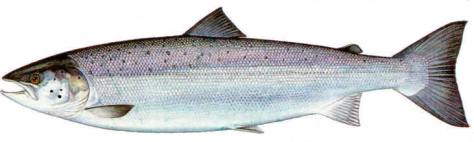
The purpose of this post is to present measurements of artificial radionuclides in wild Atlantic salmon (Salmo salar) made in 1990’s and reported in a peer reviewed paper published in the Canadian Journal of Fisheries and Aquatic Sciences by Tucker and colleagues in 1999. This post is part of an ongoing series dedicated to communicating the results of scientific research aimed at The paper combines an understanding of bioconcentration of the artificial radionuclide 137-cesium (137Cs half life ~30 years) in marine food webs with quality measurements of the contaminant in salmon that spent their lives in the North Atlantic Ocean. The North Atlantic at the time had a strong east to west gradient in 137Cs concentrations in seawater with >10 Bq m-3 in the east owing to spent nuclear fuel reprocessing in Europe and the recent impact of the Chernobyl disaster and <1.5 Bq m-3 in the west near to Canada. Salmon returning to the Ste. Marguerite River in Canada had a wide range of radiocesium in their bodies which reflected the entire range of values seen in fish harvested across the Atlantic Ocean. The results indicate that the migration routes of these salmon extended all the way across the Atlantic to the Irish and Norwegian seas. The study is relevant to understanding the impact of the Fukushima disaster on radiocesium levels in Pacific salmon as the maximum levels of contamination of seawater we see in the central and eastern North Pacific is lower than the maximum levels studies by Tucker and colleagues. Given this fact we would predict that levels of Fukushima derived contaminants in Pacific salmon and the health risk associated with the consumption of these fish will be correspondingly lower. Thus far the salmon monitoring results from the Integrated Fukushima Ocean Radionuclide Monitoring (InFORM) project are in keeping with the scientific communities understanding of 137Cs bioconcentration in fish outlined in the Tucker study and references therein.
Radionuclides in Atlantic Salmon: Bioconcentration and migration routes
When I was an undergraduate student at McGill University in Montreal, Dr. Joe Rasmussen (he is now at the University of Lethbridge in Alberta) headed up a freshwater ecology group that used radionuclides to understand energy and contaminant cycling in the aquatic environment. I remember learning about gamma spectrometry and the processing of samples for radionuclide determinations through conversations with his graduate students. Their work made an impression on me and highlighted the utility of radioisotopes for understanding rates of processes and pathways of contaminant transport in natural waters. The paper I will summarize here roughly dates to my time at McGill and is the work of Strahan Tucker who along with Marc Trudel works for Fisheries and Oceans Canada at the Pacific Biological Station in Nanaimo BC and part of the team of scientists working on the InFORM project. Tucker and colleagues exploited the east to west gradient in 137Cs activity in seawater in the North Atlantic to determine how much radiocesium was present in Atlantic salmon returning to the Ste. Marguerite River in Canada and by extension where they had migrated and fed during their growth and development. The figure below shows the high levels of seawater 137Cs contamination in the Irish Sea and eastern Atlantic compared to the western Atlantic near Canada owing to release of the isotope from fuel reprocessing plants in the UK and France and deposit of Chernobyl derived contamination in 1986.
137Cs distribution (Bq m–3) in waters of the North Atlantic with levels >10 in marginal seas of the eastern Atlantic and 0-1.5 in waters of the west near to Canada.
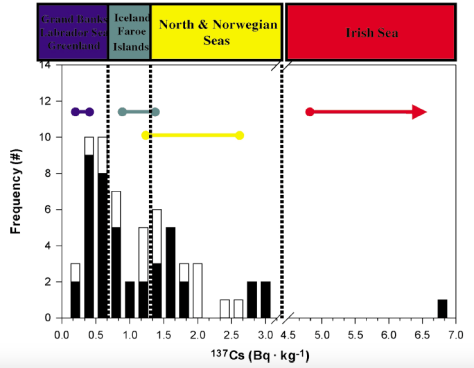
Given that salmon tend to bioconcentrate radiocesium about 130 times relative to the seawater in which the live (through the prey they consume) the predicted range in 137Cs in salmon from the eastern Atlantic would be 1.3 — 4.0 Bq kg-1 while fish living in the less contaminated western Atlantic would have 0.15 — 0.65 Bq kg-1. The range of 137Cs measured by Tucker and colleagues in salmon returning to the St. Marguerite River in Quebec, Canada, predicted ranges given seawater activities in the figure above and activities in fish harvested from different areas of the North Atlantic are summarized in the figure below.
Frequency distribution of 137Cs concentrations (Bq kg–1) in Atlantic salmon from the Ste. Marguerite River, Que. Tissue samples were obtained fish caught in the sport fishery during the summers of 1995 (n = 33) and 1996 (n = 28) and measured by gamma spectrometry. Dashed vertical lines denote the expected range in 137Cs concentrations in salmon based on a mean bioaccumulation factor of 130 from waters in the North Atlantic outlined in the color bar above (water 137Cs concentrations color coded as in the first figure). Horizontal lines denote the observed ranges in 137Cs concentrations in salmon and other fish (cod, whiting, haddock, hake, mackerel, and plaice) caught in those same waters.
The range of activities found in the migratory Atlantic salmon is similar to the range seen for other species of fish across the North Atlantic and suggests that almost half of the Ste. Marguerite salmon spent their lives feeding in waters near to Norway and the UK. This is an amazing result and suggested that more fish spend more time in the eastern Atlantic than was thought at the time. The levels seen in the salmon agree well with predictions based on seawater activities and the expected bioconcentration factor in the food web to salmon of ~130. You can read more about bioconcentration of radionuclides and concentration factors in marine organisms in one of my earlier posts here.
What does this tell us about expected contamination from Fukushima in Pacific Salmon and health risks to consumers?
The maximum seawater concentration of 137Cs in the central and eastern North Pacific we have measured through the InFORM project is about 7 — 10 Bq m-3. Given the bioconcentration expected from previous studies of salmonid species like Tucker and colleagues above we might expect maximum contamination levels in Pacific salmon of ~ 1.3 Bq kg-1 wet weight. The range of values we have detected in Pacific species returning to British Columbia rivers and streams since the Fukushima disaster in 2011 is ~0.20-0.60 Bq kg-1 suggesting that these fish have consumed prey and lived in waters with seawater activities <10 Bq m-3. At present the levels of Fukushima derived contamination do not lead to ionizing radiation doses to consumers that remotely approach the dose attributable to naturally occurring radioisotopes like 40K and 210Po. The ionizing radiation dose from the naturally occurring isotopes do not approach levels where significant risks to the health of consumers are to be expected. Given what the scientific community understands about bioconcentration of the most radiologically significant isotopes released from Fukushima and measured and forecast levels of these isotopes in the expansive North Pacific the community has confidence that levels in Pacific salmon species will not approach levels were risk to consumers will become significant. The InFORM project will continue to monitor contamination levels in seawater and the marine biota to provide accurate information and useful, scientifically derived assessment of risk to the public.



 by Goldschmidt Conference

 Home
Home 