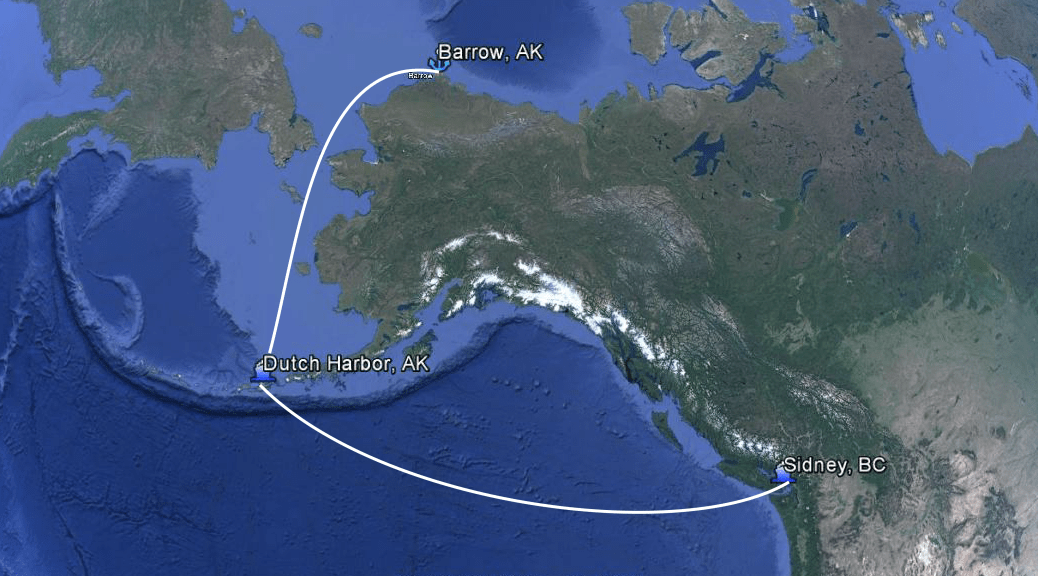
Less than half a year ago, I had absolutely no idea I would be spending three weeks at sea this summer. Now, it is only a few days before I will be aboard the CCGS Sir Wilfrid Laurier collecting surface sea water samples and processing them as part of the Fukushima InFORM project. In doing so, I am continuing the work of two other undergraduates who have been part of the monitoring efforts – Laura and Kathryn.
All Aboard!
Saskia Kowallik at her lab bench where she’ll be spending oodles of time over the next three weeks.
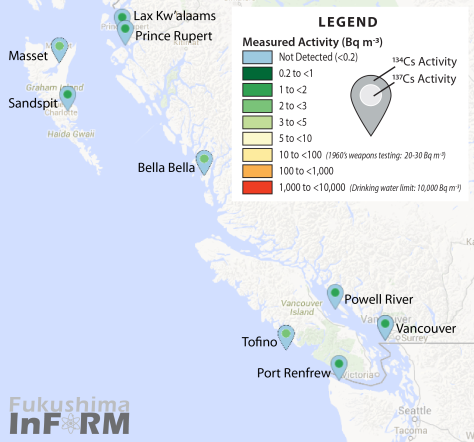
Activities of artificial radiocesium in seawater (2014-2015) and fish (2015) from the northeast Pacific Ocean measured by the InFORM project. No increase in artificial radionuclides was detected in fish compared to those harvested in 2014. Approximate range of relevant fish species relative to the contaminated plume of seawater are shown in hashed and dotted lines. Figure by Dr. Jonathan Kellogg.
With the exception of 7 fish discussed in point 3 below individual fish were not found to have detectable levels of either 134Cs or 137Cs so average levels were calculated for all fish harvested in a given location.
Similar to 2014, none of the fish from 2015 analyzed thus far were found to contain detectable levels of 134Cs a man-made radionuclide that serves as a fingerprint of the Fukushima disaster.
The average level of 137Cs seen in InFORM 2015 fish samples (0.19 Bq kg-1) is similar to the level observed in the 2014 campaign (0.21 Bq kg-1). As with 134Cs, the Fukushima disaster resulted in the release of a large quantity of 137Cs. However, 137Cs, which has a longer half-life, was already present in the Pacific Ocean prior to the Fukushima accident because of the nuclear weapons testing fallout.
The 137Cs levels observed in the 2015 InFORM samples represent a fraction of the Health Canada guidelines (1000 Bq kg-1) and a fraction of the radiation exposure owing to naturally occurring radionuclides Polonium-210 (210Po) and Potassium-40 (40K) which dominate the ionizing radiation dose to fish consumers.
While the average 137Cs concentration remained nearly identical from 2014 to 2015, 7 individualfish (out of 156) have shown a detectable level of 137Cs (ranging from 0.27 to 0.60 Bq kg-1) while individual fish from 2014 were below detection limit. Because no 134Cs was detected in these fish it is not possible to say whether detectable 137Cs can be attributed to Fukushima contamination or simply normal variability in contamination owing to nuclear weapons testing fallout.
What this means is that radioactivity from the Fukushima meltdowns has not been detected in the InFORM fish samples caught in BC waters as of summer 2015.
Neither the 137Cs present in the fish nor the naturally occurring radioisotopes in fish represent a measurable health risk to consumers in Canada.







 Home
Home 