Category Archives: Monitoring

A Diamond Jubilee for Line P

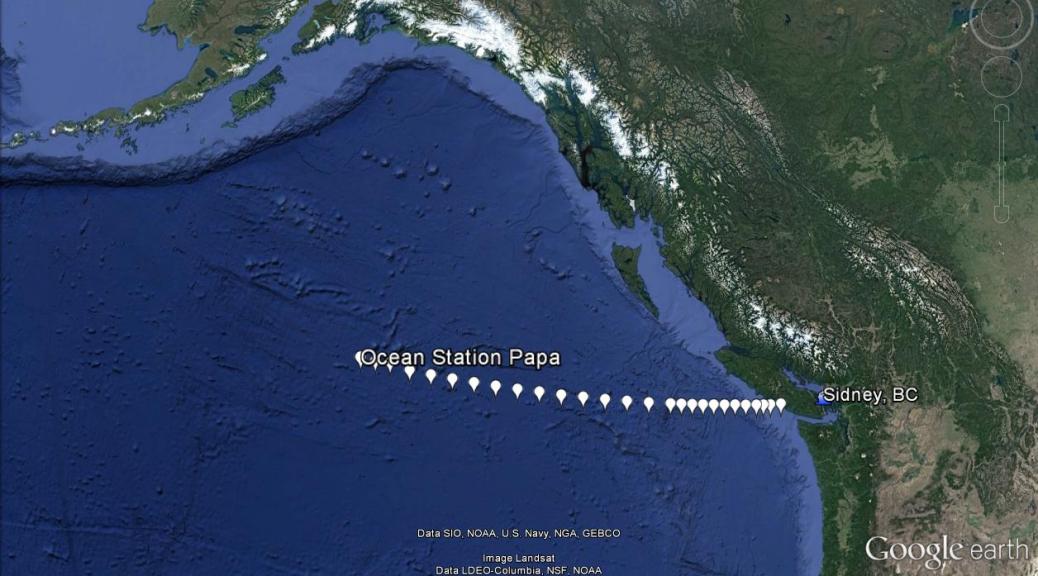
“In a time when you can work on Line P data without actually being to sea, who here has been to Station Papa?” About 2/3 of the hands in ~100 person room go up. “Who’s been since 2000?” 40 hands. “Who went in the 90’s?” 20 hands. “In the 80’s?” 10 hands. ” In the 70’s?” 5 hands. “In the 60’s?” Still, 2 hands go up. “Who’s been in winter?” 15 hands up, a hearty “Thank You!” and a round of applause from the room.

This was the amazing group that I was surrounded by at the two day meeting celebrating 60 years of science on Line P at the Institute of Ocean Sciences in Sidney, BC the last grey days of November, 2016. In this room sat some of the great forethinking oceanographers of a generation that have tirelessly pushed for continued funding, and collected samples, at what is now the longest continuously monitored station in the entire global ocean. Continue reading A Diamond Jubilee for Line P

Results from 2016 InFORM Biotic Monitoring – Shellfish and Vancouver Island Salmon

Results from 2016 shellfish monitoring show no 134-Cs or 137-Cs contamination in shellfish tissues.

Results from the shellfish meat and first 20 salmon samples collected in 2016 reveal an absence of Fukushima radiation. Shellfish from four species were collected from many of British Columbia’s major shellfish aquaculture regions from Prince Rupert to the Sunshine Coast and Vancouver Island. These results are from just the meat of the shellfish and additional analysis of the crushed shell is currently ongoing. The four types of molluscs (Pacific Scallop (Patinopecten yessoensis), Pacific Oyster (Crassostrea gigas), Northern Blue Mussel (Mytilus edulis and a hybrid with M. galloprovincalis), and Manila Clam (Venerupis philippinarum)) were chosen for analysis because previous work in other tropical species has shown that bivalves bioaccumulate cesium at rates faster than many other organisms. This work on tropical species did find that much of the cesium contamination was located in the shell so we await the results of the ongoing shell analyses. The absence of contamination in the edible meat from any of the species is reassurance to the $25 million aquaculture industry of BC that their product is safe to send to market and safe for human consumption. Continue reading Results from 2016 InFORM Biotic Monitoring – Shellfish and Vancouver Island Salmon

Pushing the Limit: Fukushima Fingerprint Isotope Found in Salmon from 2015

Results of the 2015 InFORM biotic monitoring program with updated results (larger, bold italics) where individual fish samples were reanalyzed to determine the presence of the Fukushima fingerprint isotope, 134-Cs.

For the first time, the Fukushima fingerprint isotope, cesium-134 (134Cs; half-life ~ 2 years), has been detected at an extremely low level in a Canadian salmon by the InFORM project. The single sockeye salmon that tested positive was sampled from Osoyoos Lake in the summer of 2015, according to scientists from the Radiation Protection Bureau at Health Canada, in cooperation with Fisheries and Oceans Canada and local First Nations.  The sample was one of a few (8 out of 156 total) individual fish that had trace levels of the longer lived  cesium-137 (137Cs) (30 yr half-life) that we reported on last winter. To determine if this trace 137Cs was from Fukushima or remnant from atmospheric weapons testing, InFORM reexamined these individual fish samples to see if extremely low levels of 134Cs may be present. The results of this extended analysis show that trace (0.07 Bq kg-1) levels of 134Cs were detected in one sample from Okanagan/Columbia River population. No 134Cs was detectable in the other samples. The observed levels remain well below the action level (1000 Bq kg-1) set by Health Canada guidelinesContinue reading Pushing the Limit: Fukushima Fingerprint Isotope Found in Salmon from 2015

An InFORMal Gathering – Part 2

After my tour at the University of Ottawa, the day continued with a tour of the Radiation Protection Bureau facilities over at Health Canada on the south side of the city. After clearing through security, Drs. Jean-Francois Mercier and Michael Cooke, showed Cole and I around the lab spaces that are used by the Canadian Radiological Monitoring Network and where InFORM samples are run. Continue reading An InFORMal Gathering – Part 2

An InFORMal Gathering – Part 1

The last week of September was the occasion for our funder, the MEOPAR Network (stands for Marine Environmental Prediction and Response), to have its annual scientific meeting. The two day meeting was in Ottawa, ON this year and brought together ~350 scientists from universities spanning from Victoria to St Johns. It was an opportunity for everyone to give a brief (5-10 min) update on their research, to learn about new opportunities for interdisciplinary collaboration, and what the future may bring for growing the network of scientists over the next 5 years. Continue reading An InFORMal Gathering – Part 1