Category Archives: Monitoring

Update: Sampling for Fukushima Derived Radionuclides in the Northeast Pacific and Arctic 2015

By Jay T. Cullen

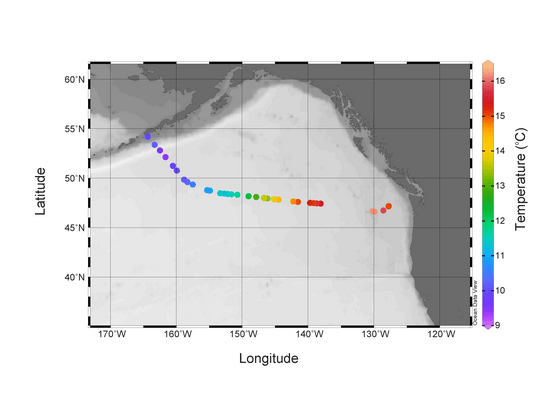
Locations where surface seawater samples were collected for the InFORM project in July 2015. Surface seawater temperatures at the time of collection are shown with values greater than 16C in the anomalous region referred to colloquially as “the blob”.


The purpose of this short post is to update readers on the activities of the Integrated Fukushima Ocean Radionuclide Monitoring (InFORM) project. This post is the most recent in a series documenting scientific research into the impact of the Fukushima Dai-ichi disaster on environmental and public health. Surface seawater samples were collected from the icebreaker CCGS Sir Wilfrid Laurier as it traveled between Victoria BC to Dutch Harbor Alaska during July 2015. These seawater samples will be analyzed to characterize the distribution of Fukushima derived radionuclides 137-Cesium (137Cs half life ~30 years), and 134-Cesium (134Cs half life ~2 years). As in previous years this information will help to determine how well model predictions of the activities and progression of ocean borne contamination across the Pacific Ocean match with observations. Understanding the spread of this contamination provides important information on the impact of the Fukushima Dai-ichi disaster on the health of the Pacific ecosystem and the North American public. The evolution of the contaminant plume in time and space also helps the scientific community to better understand ocean mixing which is a key parameter toward understanding the oceans role in mitigating atmospheric greenhouse gas increases and climate change.
Continue reading Update: Sampling for Fukushima Derived Radionuclides in the Northeast Pacific and Arctic 2015

July 2015 InFORMal Monitoring Update

July 2015 CS update-web-01
InFORMal monitoring results for water samples collected in April/May 2015

Results* from April citizen science monitoring are now available from 8 of 11 (above: bold italics) of the current InFORM sampling locations. Additionally, two samples from May are available from Ucluelet and Port Renfrew. The Ucluelet sample was collected by the Ucluelet Aquarium for our partner organization, Our Radioactive Ocean, on May 7th and did contain trace amounts (0.5 Bq m-3) of the Fukushima fingerprint, 134Cs, with it’s short ~2 year half life.  The total level of activity from this sample is roughly half the activity of the February sample, which was the last time 134Cs was detected on the BC coast.   Continue reading July 2015 InFORMal Monitoring Update

Sampling for Fukushima Derived Radionuclides in the Northeast Pacific and Arctic 2015
By Jay T. Cullen

Bow of the CCGS Laurier. Great ship and crew for science operations in the Arctic.
The purpose of this short post is to update readers on the activities of the Integrated Fukushima Ocean Radionuclide Monitoring (InFORM) project. This post is the most recent in a series documenting scientific research into the impact of the Fukushima Dai-ichi disaster on environmental and public health. Today the icebreaker CCGS Sir Wilfrid Laurier will leave Victoria BC bound for Dutch Harbor Alaska and then up through Bering Sea and Strait to the Arctic Ocean. On the way the InFORM project will collect surface seawater to characterize the distribution of Fukushima derived radionuclides 137-Cesium (137Cs half life ~30 years), and 134-Cesium (134Cs half life ~2 years). As in previous years this information will help to determine how well model predictions of the activities and progression of ocean borne contamination across the Pacific Ocean match with observations. This provides important information on the impact of this contamination on the health of the Pacific ecosystem and the North American public that rely on the ocean for their food, livelihood and recreation. The evolution of the contaminant plume in time and space also helps the scientific community to better understand ocean mixing which is a key parameter toward understanding the oceans role in mitigating atmospheric greenhouse gas increases and climate change. Continue reading Sampling for Fukushima Derived Radionuclides in the Northeast Pacific and Arctic 2015

Update: Monitoring Results For Sockeye Salmon and Steelhead Trout Collected Summer 2014

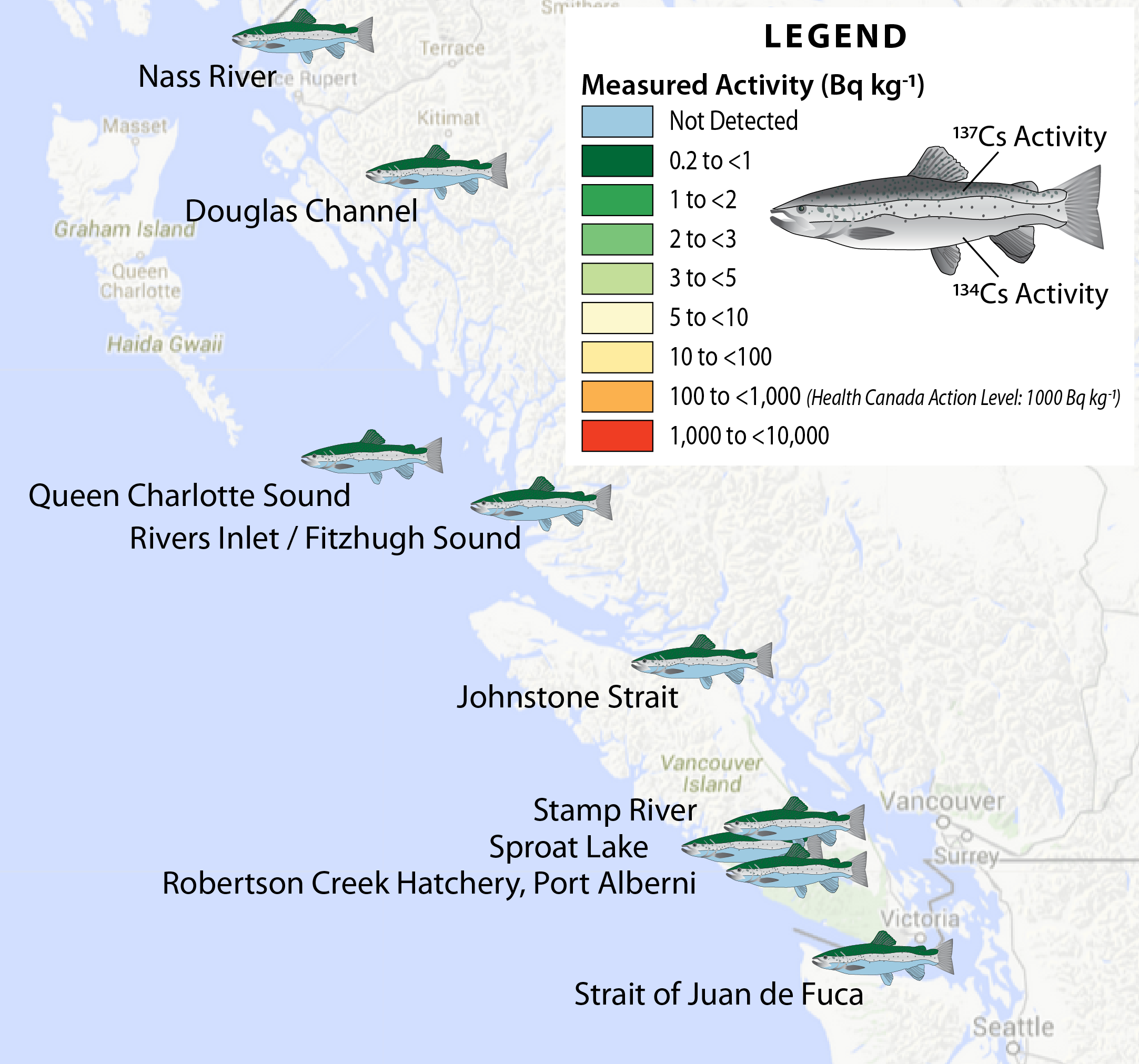
Summary of the amount of radioactive cesium isotopes in sockeye salmon and steel head trout harvested from BC waters in 2014 (Figure by Jonathan Kellogg jkellogg@uvic.ca).

The measurements undertaken as part of the InFORM project to look for Fukushima derived radionculides in fish during our first of three years of monitoring are now complete. Sockeye salmon (Oncorhynchus nerka) and Steelhead Trout (Oncorhynchus mykiss) (as well as some Chinook, Chum and Pink Salmon) were caught off the west coast of Canada in Summer 2014 as they were returning to 9 different streams and rivers up and down the coast of British Columbia Canada. These results add to the first 19 fish which we reported on in December of 2014.

Continue reading Update: Monitoring Results For Sockeye Salmon and Steelhead Trout Collected Summer 2014

Health Canada/InFORM Analyses of the Radioactive Content of Fish Samples from Canada’s West Coast

This page mirrors information on the radionuclide content of fish measured by Health Canada and the InFORM project that can be found at Open Government, Open Data.

Continue reading Health Canada/InFORM Analyses of the Radioactive Content of Fish Samples from Canada’s West Coast