All posts by dr.jonathan.kellogg

Screening truffles for radioactivity 30 years from Chernobyl

IMAGE
Miro is a trained truffle dog that belongs to Simon Egli, a co-author of the Biogeosciences paper based at Swiss Federal Research Institute WSL. He’s pictured here with a Burgundy truffle he found in Switzerland. Credit: Simon Egli, WSL

by European Geosciences Union
EurekAlert
Published 25 Feb 2016

Some forest mushrooms, such as wild porcini, can accumulate dangerous levels of radioactivity from the soils they grow in. But until now it was unclear if the same was true for truffles, fungi that range among the most expensive foods in the world. Swiss and German researchers have analysed Burgundy truffles collected in central Europe and found they contain only negligible amounts of radioactive caesium, being safe for consumption. The results are published today (25 February) in Biogeosciences, an open access journal of the European Geosciences Union (EGU).

Continue reading Screening truffles for radioactivity 30 years from Chernobyl

No radiation from Japan’s Fukushima disaster found in BC fish

No radiation from Japan's Fukushima disaster found in B.C. fish
John Nightingale, president of the Vancouver Aquarium, said at a 2014 news conference by the Arctic char tank at Vancouver Aquarium that radiation levels are barely above background levels since the 2011 meltdown of nuclear reactors at Fukushima caused by the earthquake and tsunami.

By Bethany Lindsay
Vancouver Sun
Published 23 Feb 2016

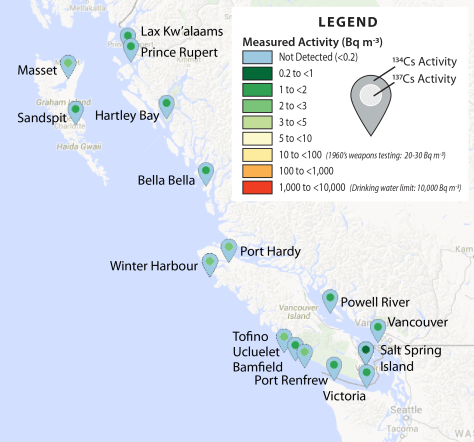
Nearly five years after a massive earthquake resulted in the Fukushima nuclear disaster in Japan, researchers in B.C. have found no detectable levels of contamination in fish along the West Coast.

Continue reading No radiation from Japan’s Fukushima disaster found in BC fish

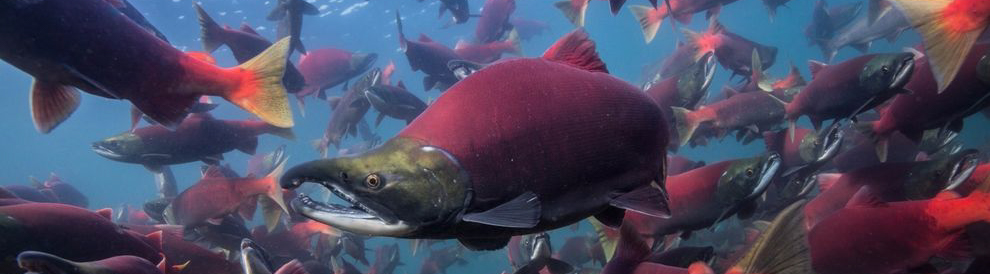
Radiation from Fukushima nuclear disaster not found in B.C. salmon

‘The amount of radioactivity from these isotopes from Fukushima in our water or in our fish [is] a fraction of the count you’d get using a Geiger counter,’ University of Victoria’s Dr. Jay Cullen said. (John Lehmann/The Globe and Mail)
By Mark Hume
The Globe and Mail
Published 23 Feb 2016

Five years after the Fukushima nuclear accident in Japan, radioactive contaminants continue to circulate across the Pacific to Canada’s West Coast, but not at dangerous levels.

Continue reading Radiation from Fukushima nuclear disaster not found in B.C. salmon

Episodic Tremor and Slip

2016 ETS
Progression of the latest tremor episode in British Columbia and Washington. Over 10,000 tremors were detected between December 22, 2015 and January 16, 2016. Source: PNSN.

On the evening of December 29th, most of southern BC and northwest Washington felt the jolt of the M4.8 earthquake that was located 19 km NNE of Victoria. While minimal damage was reported, it served as a reminder to many that this is a seismically active region.

However, no one felt the 10,000 small earthquakes, or tremors, that began on December 22nd and continued through January 16th. Yet, combined, these small movements released enough energy to be equivalent to a M6.5 earthquake, or about 350 times the release experienced on December 29th.

Continue reading Episodic Tremor and Slip