
All posts by dr.jonathan.kellogg

A Diamond Jubilee for Line P

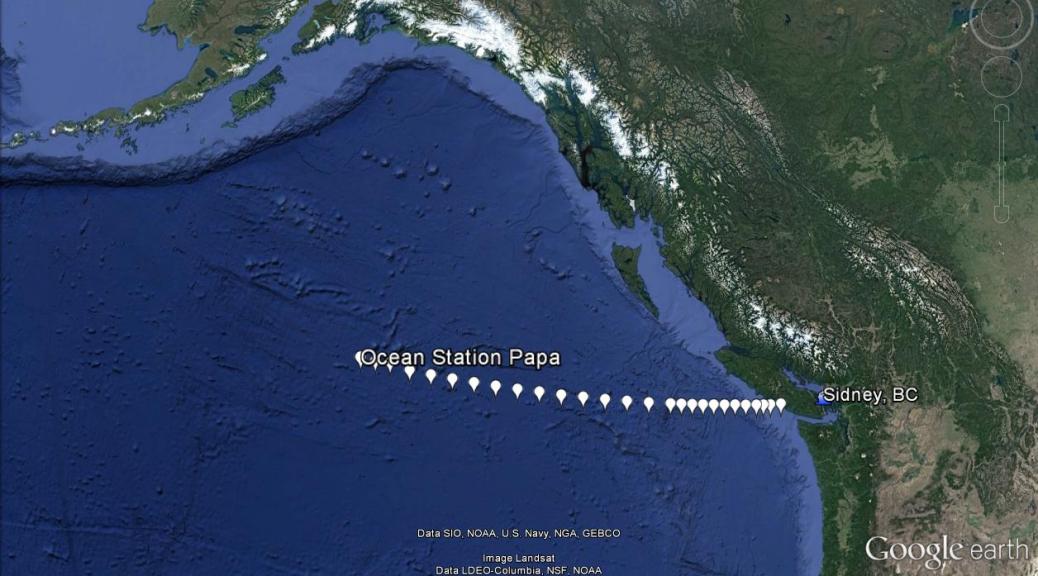
“In a time when you can work on Line P data without actually being to sea, who here has been to Station Papa?” About 2/3 of the hands in ~100 person room go up. “Who’s been since 2000?” 40 hands. “Who went in the 90’s?” 20 hands. “In the 80’s?” 10 hands. ” In the 70’s?” 5 hands. “In the 60’s?” Still, 2 hands go up. “Who’s been in winter?” 15 hands up, a hearty “Thank You!” and a round of applause from the room.

This was the amazing group that I was surrounded by at the two day meeting celebrating 60 years of science on Line P at the Institute of Ocean Sciences in Sidney, BC the last grey days of November, 2016. In this room sat some of the great forethinking oceanographers of a generation that have tirelessly pushed for continued funding, and collected samples, at what is now the longest continuously monitored station in the entire global ocean. Continue reading A Diamond Jubilee for Line P

Dr Cullen Interviewed on CFAX 1070 Dec 12, 2016

Dr. Jay Cullen was interviewed by Victoria’s CFAX 1070 on Dec 12, 2016 about recent InFORM and Our Radioactive Ocean findings of cesium 134 in BC salmon and a sample from Tillamook & Gold Beach, Oregon, respectively. Take a listen.

Should we be worried about Fukushima radiation?

ap-japan-nuclear
This Jan. 12, 2016 photo, shows No. 3 nuclear reactor, bottom, at Takahama nuclear power station in Takahama town in Fukui prefecture, northwestern Japan. Japan has restarted a nuclear reactor that burns plutonium-based fuel for power generation, first under the post-Fukushima safety rules. The No. 3 reactor at Takahama nuclear plant in western Japan, operated by Kansai Electric Power Co., becomes the first one using plutonium-uranium hybrid fuel known as MOX to go back online since the 2011 meltdowns at Fukushima. (Photo: AP)

by Mary Bowerman and Tracy Loew
USA Today
Published 9 Dec 2016

For the first time, seaborne radiation from Japan’s Fukushima nuclear disaster has been detected on the West Coast of the United States.

The levels are very low and shouldn’t harm people eating fish from the West Coast or swimming in the ocean, according to Ken Buesseler, a senior scientist at Woods Hole Oceanographic Institution. 

Continue reading Should we be worried about Fukushima radiation?

Fukushima radiation has reached U.S. shores

by Tracy Loew
Statesman Journal 
Published 7 Dec 2016

For the first time, seaborne radiation from Japan’s Fukushima nuclear disaster has been detected on the West Coast of the United States.

Cesium-134, the so-called fingerprint of Fukushima, was measured in seawater samples taken from Tillamook Bay and Gold Beach in Oregon, researchers from the Woods Hole Oceanographic Institution are reporting. Continue reading Fukushima radiation has reached U.S. shores

Aftershock rattles Japan’s Fukushima region

A Mw 6.9 aftershock shook the Iwaki region of the coast of Japan on November 22, 2016. Considered an aftershock, since it was within 2 rupture lengths of the  2011 Great East Japan earthquake that itself ruptured a 300 km stretch of seafloor, this is just the latest shaker of the hundreds of quakes >Mw 4 that have occurred since March 11th, 5 years ago. While on the human timescale, there has been enough time for many structures to be rebuilt and life to return to normal for many, geologically speaking the M9 quake is still reasonably fresh. While aftershocks DO get more spaced out in time since the main shock, they do not necessarily become weaker and so this is unlikely to be the last tremor of this magnitude in the area. Continue reading Aftershock rattles Japan’s Fukushima region