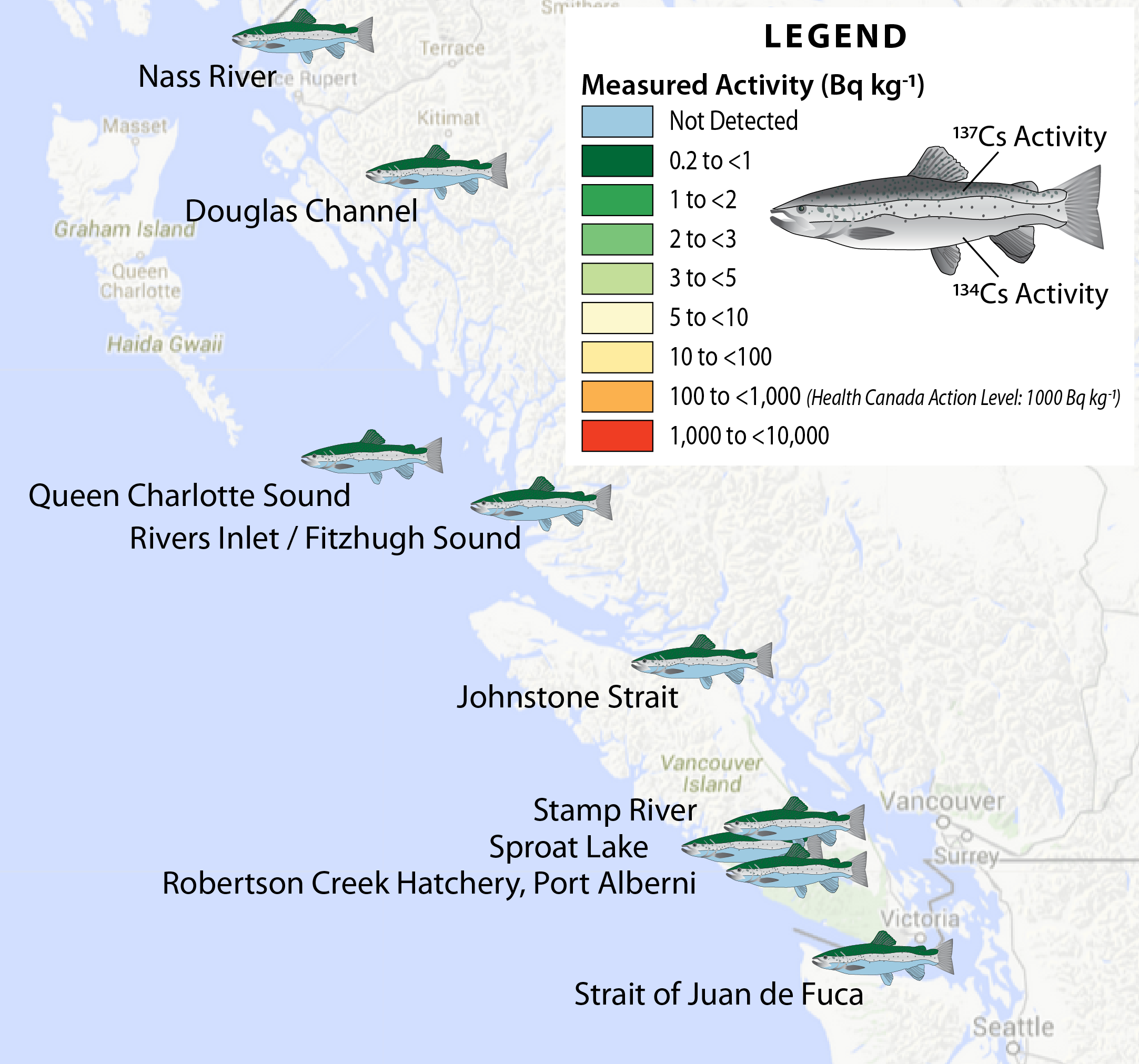
Summary of the amount of radioactive cesium isotopes in sockeye salmon and steel head trout harvested from BC waters in 2014 (Figure by Jonathan Kellogg jkellogg@uvic.ca).
The measurements undertaken as part of the InFORM project to look for Fukushima derived radionculides in fish during our first of three years of monitoring are now complete. Sockeye salmon (Oncorhynchus nerka) and Steelhead Trout (Oncorhynchus mykiss) (as well as some Chinook, Chum and Pink Salmon) were caught off the west coast of Canada in Summer 2014 as they were returning to 9 different streams and rivers up and down the coast of British Columbia Canada. These results add to the first 19 fish which we reported on in December of 2014.
Radiation from Fukushima reactor detected off Vancouver Island
This satellite image provided by DigitalGlobe shows the damaged Fukushima Dai-ichi nuclear facility in Japan on Monday, March 14, 2011. Radiation from the leaking Fukushima nuclear reactor in Japan has been detected on the shores of Vancouver Island. Scientists say it’s the first time since a tsunami in Japan four years ago that radiation has been found on the shorelines of North America. (AP Photo/DigitalGlobe)
Dirk Meissner, The Canadian Press
Published Monday, April 6, 2015 7:32PM EDT
VICTORIA — Radiation from the leaking Fukushima Daiichi nuclear reactor has been detected on the shores of Vancouver Island, four years after a deadly earthquake and tsunami in Japan killed 16,000 people.
University of Victoria chemical oceanographer Jay Cullen said Monday that it’s the first time radiation has been found on the shorelines of North America since the quake and tsunami ravaged the Japanese north coast and disabled the nuclear reactor. Continue reading Radiation from Fukushima reactor detected off Vancouver Island→
Residents gathered to hear of the effects of the 2011 Japanese Tsunami
Devon Johnson
6/4/2015
Four years later, debris continues to wash ashore on Haida Gwaii and the BC Coast from the 2011 Japanese tsunami. This week, Prince Rupert and Terrace residents listened to two experts talk about the severe impact the tsunami is continuing to have.As waves crash against BC’s Northern Shores, more debris is being discovered says Shoreline Cleanup Manager Kate Le Souef.
“The quantity of debris that we’re finding on the coast line is probably what is the most shocking. So, for example we pulled 4 tonnes of debris off the West Coast trail just in a day of cleanup.”
Map showing the location of public talks for the InFORM project June 1-4, 2015.
The purpose of this post is to report on a recent public discussion tour to convey the latest results of the Integrated Fukushima Ocean Radionuclide Monitoring (InFORM) network to residents of the north coast of British Columbia. This post continues a series aimed to report the results of scientific research into the impact of the Fukushima disaster on the environment. Between June 1-4, 2015 I traveled from Victoria up to Haida Gwaii, over to Prince Rupert and up the Skeena River to Terrace and gave 8 public talks to communicate the results of the networks monitoring efforts to determine the impact of the Fukushima Dai-ichi meltdowns on the health of the northeast Pacific and residents of the North American west coast. I was able to meet three of our citizen scientist volunteers who have been collecting shoreline samples to look for Fukushima derived contamination of coastal seawater. The response to these presentations was overwhelmingly positive and the public asked very useful questions about monitoring thus far. Despite the overall usefulness of the discussions some old misinformation keeps rearing its head. Here I’ll show some of the beautiful spots on our coast and begin the process of addressing some more of the misinformation related to Fukushima impacts on the west coast. Continue reading Question and Answer: Public Discussion of Fukushima Impact on the West Coast of North America→
Note that the video above was shot on May 8, 2015, set to Debussy’s Clair de Lune, by the YouTube user NorthOlbo who makes wonderful pieces about the British Columbian coast. Check him out.
The purpose of this more visual post is to report on a recent trip my students and I took to a local beach and what we saw there. Botanical Beach is renowned for its tide pools and part of the Juan de Fuca Provincial Park here on the southwest coast of Vancouver Island, British Columbia Canada. There are strange conditions currently in the northeast Pacific from the “blob” of warm water related to anomalous winter mixing in 2013-2014 to the widespread disappearance of sea stars owing to wasting disease after infection by virus. Some link these changes in the marine ecosystem to the very low levels of Fukushima derived radioisotope contamination present offshore and recently detected at the shoreline although there is little evidence to support such views nor are such impacts very likely. There is indeed life abundant at Botanical Beach but it is changing. The sea star is a keystone predator whose removal has consequences. The most obvious of these on visiting the beach again was the predominance of California mussels to be found. More about our adventure below the fold. Continue reading Sea Star Loss From Our Coast Might Be Mussels Gain→



 Home
Home 