
Tag Archives: 134-Cs

Sampling for Fukushima Derived Radionuclides in the Northeast Pacific and Arctic 2015

By Jay T. Cullen

Bow of the CCGS Laurier. Great ship and crew for science operations in the Arctic.
The purpose of this short post is to update readers on the activities of the Integrated Fukushima Ocean Radionuclide Monitoring (InFORM) project. This post is the most recent in a series documenting scientific research into the impact of the Fukushima Dai-ichi disaster on environmental and public health. Today the icebreaker CCGS Sir Wilfrid Laurier will leave Victoria BC bound for Dutch Harbor Alaska and then up through Bering Sea and Strait to the Arctic Ocean. On the way the InFORM project will collect surface seawater to characterize the distribution of Fukushima derived radionuclides 137-Cesium (137Cs half life ~30 years), and 134-Cesium (134Cs half life ~2 years). As in previous years this information will help to determine how well model predictions of the activities and progression of ocean borne contamination across the Pacific Ocean match with observations. This provides important information on the impact of this contamination on the health of the Pacific ecosystem and the North American public that rely on the ocean for their food, livelihood and recreation. The evolution of the contaminant plume in time and space also helps the scientific community to better understand ocean mixing which is a key parameter toward understanding the oceans role in mitigating atmospheric greenhouse gas increases and climate change. Continue reading Sampling for Fukushima Derived Radionuclides in the Northeast Pacific and Arctic 2015
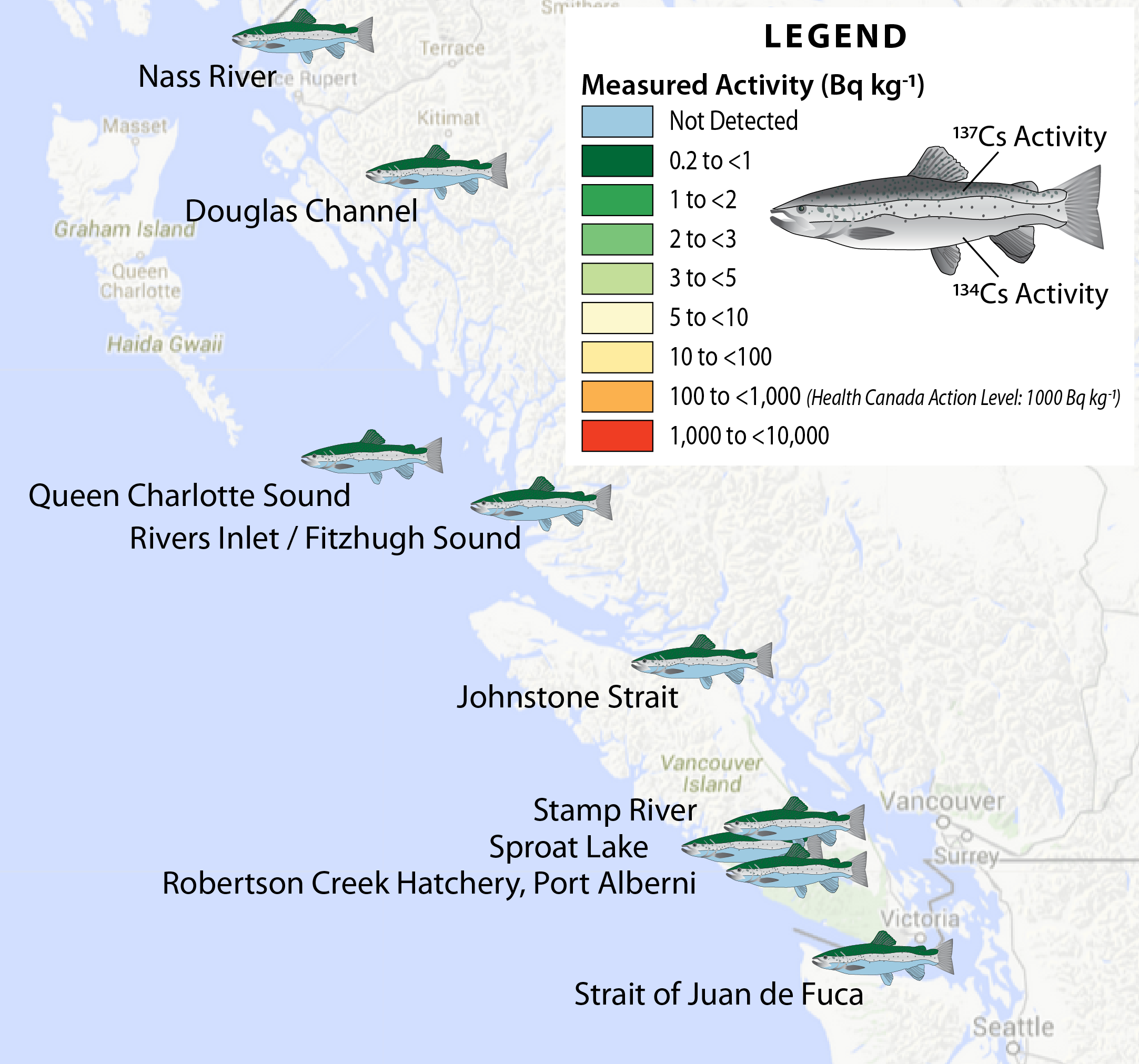
Update: Monitoring Results For Sockeye Salmon and Steelhead Trout Collected Summer 2014

Summary of the amount of radioactive cesium isotopes in sockeye salmon and steel head trout harvested from BC waters in 2014 (Figure by Jonathan Kellogg jkellogg@uvic.ca).

The measurements undertaken as part of the InFORM project to look for Fukushima derived radionculides in fish during our first of three years of monitoring are now complete. Sockeye salmon (Oncorhynchus nerka) and Steelhead Trout (Oncorhynchus mykiss) (as well as some Chinook, Chum and Pink Salmon) were caught off the west coast of Canada in Summer 2014 as they were returning to 9 different streams and rivers up and down the coast of British Columbia Canada. These results add to the first 19 fish which we reported on in December of 2014.

Continue reading Update: Monitoring Results For Sockeye Salmon and Steelhead Trout Collected Summer 2014

Radiation from Fukushima reactor detected off Vancouver Island

Radiation from Fukushima reactor detected off Vancouver Island

Fukushima Dai-ichi radiation Vancouver
This satellite image provided by DigitalGlobe shows the damaged Fukushima Dai-ichi nuclear facility in Japan on Monday, March 14, 2011. Radiation from the leaking Fukushima nuclear reactor in Japan has been detected on the shores of Vancouver Island. Scientists say it’s the first time since a tsunami in Japan four years ago that radiation has been found on the shorelines of North America. (AP Photo/DigitalGlobe)
 Dirk Meissner, The Canadian Press


Published Monday, April 6, 2015 7:32PM EDT

VICTORIA — Radiation from the leaking Fukushima Daiichi nuclear reactor has been detected on the shores of Vancouver Island, four years after a deadly earthquake and tsunami in Japan killed 16,000 people.

University of Victoria chemical oceanographer Jay Cullen said Monday that it’s the first time radiation has been found on the shorelines of North America since the quake and tsunami ravaged the Japanese north coast and disabled the nuclear reactor. Continue reading Radiation from Fukushima reactor detected off Vancouver Island

More Fukushima Question and Answer: Why don’t you measure contamination in marine algae?

By Jay T. Cullen

Diatoms under the microscope. Important marine algae that form the base of the food web in oceanic environments. From http://www.nsf.gov/news/news_images.jsp?cntn_id=128913&org=NSF


The purpose of this post is to address common questions related to Fukushima monitoring efforts being conducted by the Integrated Fukushima Ocean Radionuclide Monitoring (InFORM) network in the northeast Pacific Ocean and coastal waters of Canada. This diary continues a series aimed to report the results of scientific research into the impact of the Fukushima disaster on the environment. I am asked routinely why we do not measure contamination in marine microalgae, the base of the marine foodweb, given that they concentrate radionuclide contamination from Fukushima found in seawater into their cells as they grow. The extremely low levels of contamination found from Fukushima in the northeast Pacific Ocean combined with the very small amounts of microalgae present in oceanic waters make such monitoring logistically infeasible. Follow below the fold for the detailed answer. Continue reading More Fukushima Question and Answer: Why don’t you measure contamination in marine algae?

Status of the Spent Fuel At Fukushima Dai-ichi: How much was released to the environment?

By Jay T. Cullen

The purpose of this post is to answer the question posed in the title by summarizing a recently published peer reviewed study in the journal Nuclear Engineering and Design. The diary is part of an ongoing effort to communicate results from scientific studies aimed at understanding the impact of the Fukushima Dai-ichi meltdowns on the environment. The paper by Jäckel compares measured and predicted activities of reactor products 134-Cesium (134Cs half life ~2 years) and 137-Cs (137Cs half life ~30 years) in the reactor cores and spent fuel to measurements in the spent fuel pools (SFPs) of Units 1, 2, 3 and 4 at the site to determine how much spent fuel radiocesium was released after the accident. The comparison indicates that only very minor damage to the spent fuel occurred during the accident and subsequent clearing work such that at most about 1% of the Cs inventory from a single bundle (in Unit 2 SFP) was released to the cooling water. The short answer to the question is that not very much of the spent fuel was released at all and the bulk of releases originated from the reactor fuel in Units 1, 2 and 3 at the time of the accident. This is consistent with the results of measurements made of Fukushima derived radionuclides in air, soil and water worldwide since March 2011. Continue reading Status of the Spent Fuel At Fukushima Dai-ichi: How much was released to the environment?