
Tag Archives: 134-Cs

Monitoring Results For Sockeye Salmon and Steelhead Trout Collected Summer 2014

The Integrated Fukushima Ocean Radionuclide Monitoring (InFORM) project is a network involving academic, governmental, and non-governmental organizations, as well as citizen scientists. InFORM is acquiring data to support a thorough radiological impact assessment for Canada’s west coast stemming from the Fukushima Dai-ichi nuclear power plant (FD-NPP) accident, and to effectively communicate these results to the public. The first measurements undertaken as part of the InFORM project to look for Fukushima derived radionculides were made on 19 fish in collaboration with the Nisga’a First Nation. Sockeye salmon (Oncorhynchus nerka) and Steelhead Trout (Oncorhynchus mykiss) were caught off the west coast of Canada in Summer 2014 as they were returning to the Nass River in northern BC.

Measurements of radioactive elements in these fish are reported in the data table below and are available for download through Health Canada:

Sample

137-Cs (Bq/kg)

134-Cs (Bq/kg)

40-K (Bq/kg)

210-Po (Bq/kg)

Steelhead #1

< 1.5

< 1.3

155 (23)


Steelhead #2

< 1.4

< 1.3

136 (21)


Steelhead #3

< 1.4

< 1.4

126 (22)

1.7 (0.5)

Steelhead #4

< 1.4

< 1.3

146 (22)


Steelhead #5

< 1.4

< 1.4

135 (21)


Steelhead #6

< 0.9

< 1.8

158 (29)


Steelhead #7

< 1.3

< 1.3

125 (21)


Steelhead #8

< 1.4

< 1.3

113 (20)

1.3 (0.4)

Steelhead #9

< 1.5

< 1.4

136 (21)


Steelhead #10

< 1.3

< 1.2

113 (21)


Sockeye #1

< 1.9

< 1.8

187 (29)


Sockeye #2

< 1.4

< 1.4

175 (23)


Sockeye #3

< 1.3

< 1.3

148 (21)

<0.2

Sockeye #4

< 1.4

< 1.3

160 (22)


Sockeye #5

< 1.4

< 1.3

149 (22)


Sockeye #6

< 1.3

< 1.4

129 (22)


Sockeye #8

< 1.4

< 1.3

130 (22)


Sockeye #9

< 1.3

< 1.3

142 (22)

0.5 (0.2)

Sockeye #10

< 1.4

< 1.4

112 (23)


Samples Combined (average)

0.27 (0.04)

< 0.18

168 (5)

0.9 (0.3)

Numbers with “<” indicate that levels were below the detection limit of the analysis and numbers inside parenthesis “( )” report the uncertainty associated with the measurement.

What are we measuring and why?

The triple meltdowns at the Fukushima Dai-ichi nuclear power plant (NPP) released many different radioisotopes to the environment, however only a very few of these are both measurable and unique to Fukushima. A reliable finger-print radioisotope for Fukushima is Cesium-134 (134-Cs half life ~ 2 years). This is because 134-Cs is only produced in nuclear reactors and it has a relatively short half-life, so that 134-Cs from other human sources, like the Chernobyl NPP disaster in 1986, are no longer present in the environment. Other isotopes such as Cesium-137 (137-Cs half life ~30 years) are not positive indicators of Fukushima since they were also a products of atmospheric testing in the 20th century and Chernobyl and are still present in the environment from these legacy sources.


How scientists talk about radioactivity in the environment

Scientists use a variety of units to measure radioactivity. A commonly used unit is the Becquerel (Bq for short) which represents an amount of radioactive material where one atom decays per second and has units of inverse time (per second). Another unit commonly used is disintegrations per minute (dpm) where the number of atoms undergoing radioactive decay in one minute are counted (so 1 Bq = 60 dpm). The measurements above represent that numbers of Bq detected in a kilogram of fish flesh.


Measurements of Sockeye Salmon and Steelhead Trout

We measured the activities of cesium radioisotopes 134-Cs and 137-Cs that were released in large quantities from the Fukushima Dai-ichi Nuclear Power Plant disaster in 2011. We also measured naturally occurring radioisotopes Potassium-40 (40-K) and Polonium-210 (210-Po) that always contribute doses of radiation to human consumers of marine fish. Samples of sockeye salmon and steelhead returning to the Nass River in northern BC, obtained from the Nisga’a First Nation, were analyzed and none were found to contain detectable levels of Fukushima derived radionuclides. By adding together the signals obtained for all of the samples we calculate an average activity concentration of 0.27 Bq/kg for 137-Cs.  This represents residual 137-Cs in the North Pacific largely from atmospheric nuclear weapons testing in the last century.  At present, Fukushima derived radionuclides cannot be detected. Nuclear weapons testing fallout (137-Cs) can be detected in BC fish at levels that represent a fraction of the radiation exposure owing to naturally occurring radionuclides neither of which represent a dangerous health risk to consumers in Canada.  Results for a further ~80 fish collected this summer and fall from various returning runs up and down the BC coast will be reported as samples are analyzed.


The Importance of Salmon to Canadians

Pacific salmon are economically, culturally, and ecological significant species to British Columbia. On an annual basis, the commercial, recreational, and First Nation salmon fisheries contribute over $600 million in revenues. They are an important food source to First Nations and coastal communities, and numerous animal species such as endangered Killer Whales, Gray Wolf, Grizzly Bear, seabirds, and insects. They provide nutrients to freshwater ecosystems and riparian habitats through the decomposition of their carcass.

There are six species of Pacific salmon in British Columbia. During the first year of the project, InFORM will focus primarily on Sockeye Salmon (Oncorhynchus nerka) and Steelhead Trout (Oncorhynchus mykiss), though other salmon species have and will be examined. Both species typically spend 2-3 years in the North Pacific Ocean prior to returning to their natal streams and venture further west than any other salmon species (Figure 1-2). On an annual basis, 1-10 million Sockeye Salmon are commercially harvested for human consumption and ceremonial purposes. In contrast, the fishery for Steelhead Trout is primarily catch and release due to conservation concerns for this species, particularly in Southern British Columbia. Although wild Steelhead Trout are not frequently consumed in Canada, their extensive westward migration that brings them close to the coast of Japan makes them an ideal canary species for monitoring radiation levels in salmon species originating from British Columbia.

Figure 1. Approximate range for the distribution of Sockeye Salmon in the North Pacific Ocean originating from North America and Asia. Source: http://www.pac.dfo-mpo.gc.ca/fm-gp/species-especes/salmon-saumon/facts-infos/sockeye-rouge-eng.html


steelhead_trout_small
Figure 2. Approximate range for the distribution of Steelhead Trout in the North Pacific Ocean originating from British Columbia (red) and Washington, Oregon, and California (green). Source: http://www.pac.dfo-mpo.gc.ca/fm-gp/species-especes/salmon-saumon/facts-infos/steel-arc-eng.html

Technical Information Regarding Sample Analyses

  • 19 fish samples, flesh only (9 Sockeye Salmon and 10 Steelhead Trout) were obtained from the Nisga’a First Nation
  • A sub-sample of ~125g of wet mass (average wet mass (measured) = 126.67 g) was taken and placed in a sample counting container
  • Gamma-radiation emitting isotopes were measured by gamma spectroscopy using a high purity germanium detector and each sample being counted for 6 hours
    • Planar BE5030 high purity germanium (HPGe) detector with relative counting efficiency of 46%
    • counting geometry = Parkway Jar (Polyethylene, active volume = 129 mL) placed in a polyacrylate sample holder (2.95 mm thickness)
    • counting efficiency was determined by applying an empirical efficiency curve, determined from a multi-nuclide (12) standard (Eckert and Ziegler Analytics, SRS: 79535-411) of similar density (1.15 g/cm^3, Parkway Jar format) spanning energies of 46.5 – 1836.1 KeV
    • true coincidence summing (where applicable) is accomplished by extracting detailed decay scheme data from the UniSampo-Shaman nuclide library
  • Spectral summation was done by adding all the spectrum into a single one and then reanalysed using UniSampo-Shaman gamma spectral analysis software from Baryon Oy, Ltd., Finland, with decay correction to the catch date of August 28, 2014

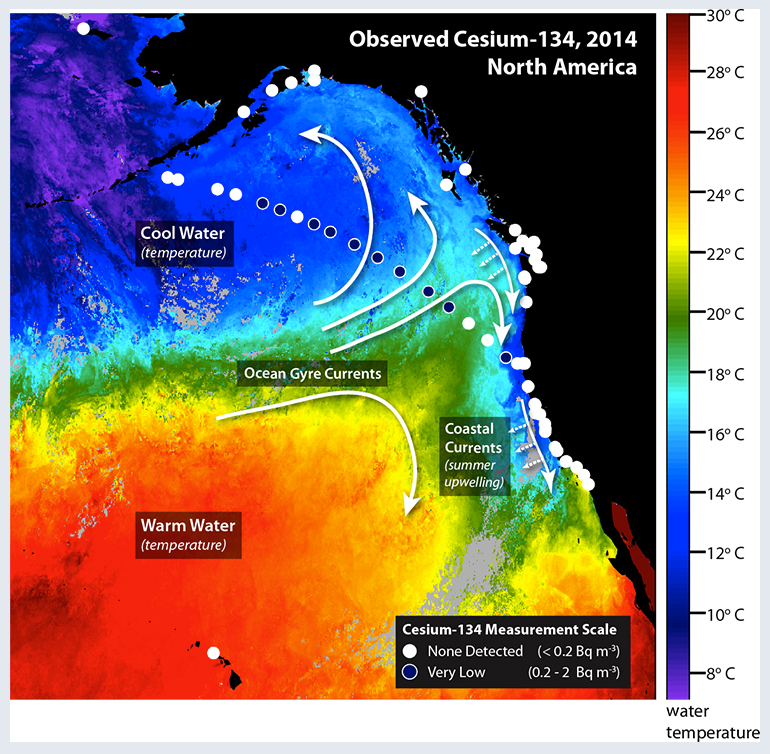
 

Most Recent Measurements of Fukushima Derived Isotopes in the Northeast Pacific Ocean

By Jay T. Cullen

Satellite measurements of ocean temperature (illustrated by color) from July 28th to August 4th and the direction of currents (white arrows) help show where radionuclides from Fukushima are transported. Large scale currents transport water westward across the Pacific. Upwelling along the west coast of North America in the summertime brings cold deep water to the surface and transports water offshore. Circles indicate the locations where water samples were collected. White circles indicate that no cesium-134 was detected. Blue circles indicate locations were low levels of cesium-134 were detected. No cesium-134 has yet been detected along the coast, but low levels have been detected offshore. (Woods Hole Oceanographic Institution)

The purpose of this post is to report on new results coming out the crowd-funded Our Radioactive Ocean program headed up by Dr. Ken Buesseler of Woods Hole Oceanographic Institution. This post is part of an ongoing series dedicated to scientific inquiry into the impact of the triple meltdowns at Fukushima on the health of the North Pacific Ocean and residents of the west coast of North America. Measurements of the cesium radioisotopes 134-Cs (half life ~ 2 years) and 137-Cs (half life ~30 years) were made on samples collected on a transect between Monterey Bay CA and Dutch Harbor AK this summer. Because of its relatively short half life 14-Cs serves as an unequivocal tracer of Fukushima contamination in the environment. Fukushima derived 134-Cs was detected at offshore stations with a maximum activity of ~ 2 Bq/m^3 and total 137-Cs activities of ~7 Bq/m^3 of seawater. Measurements have yet to detect 134-Cs in nearshore waters sampled up and down the North American west coast. These activities of Cs are orders of magnitude below levels thought to pose a measurable risk to human health or marine life, according to international health agencies.


For a primer on radioactivity in the ocean and the units used to discuss radioactive elements in the environment please visit this post.

A press release from WHOI regarding these new results can be found here and details about sampling locations and activities of Cs detected are available here.

At a great majority of sites sampled along the coast and offshore the activity of 134-Cs is below detection limit (~legacy contamination resulting from atmospheric weapons testing in the 20th century. Similar to previous work by Dr. John Smith of the Department of Fisheries and Oceans Canada the presence of the contaminated plume of seawater owing to releases from Fukushima can be detected in offshore stations (150 – 1500 km) with levels of 134-Cs approaching 2 Bq/m^3 and total 137-Cs (bomb + Fukushima) of about ~7 Bq/m^3. These levels of 137-Cs are similar to levels in the North Pacific Ocean that were present in 1990 owing to the combined effects of Chernobyl and weapons testing fallout as shown in the figure below.

Activity of 137-Cs in the North Pacific after Povinec and others (2013) http://www.biogeosciences.net/10/5481/2013/bg-10-5481-2013.html with arrows indicating the impact of Chernobyl, 2008 137-Cs activity in the Irish Sea and 2014 levels offshore of western North America post Fukushima for comparison.
Activities of these isotopes were about 10 million fold higher in coastal waters near the Fukushima Dai-ichi nuclear power plant off Japan in the weeks following the beginning of the disaster in March and April 2011 when rates of release and seawater concentrations were at their peak. Current releases from the plant support seawater activities on the order of 10’s-100’s of Bq/m^3 within 2 km of the plant site. The highest activities associated with the most contaminated seawater from Fukushima are predicted to travel across the North Pacific with prevailing currents and arrive in North American waters between this year and next. These offshore activities of Fukushima derived 137-Cs of ~ 5 Bq/m^3 exceed predicted activities of ~3 Bq/m^3 suggesting that offshore activities are likely reaching near peak values. The measurements being made by the international scientific community will undoubtedly help to improve our understanding of mixing and transport in the oceans.

The activities of radiocesium being detected offshore are well below levels thought to represent significant radiological health risks to marine organisms or residents of the west coast of North America. To this point no 134-Cs from the contaminated plume approaching the coast has been detected in nearshore waters. Ongoing monitoring by programs like Our Radioactive Ocean and its partner program InFORM which are making measurements of contamination in seawater and marine organisms will be key to understanding impacts of the Fukushima on our environment.

Update on Fukushima Plutonium Releases to the Pacific Ocean

By Jay T. Cullen

This post reports on the most recent study of plutonium releases from Fukushima to the Pacific Ocean. The post contributes to an ongoing effort to report peer-reviewed studies on the impact of the triple meltdowns at the Fukushima Dai-ichii nuclear power plant on the health of the Pacific ecosystem and residents of the west coast of North America. Plutonium is an alpha-emitting isotope that carries significant radiological health risks if internalized with risk of exposure increasing with the activity of Pu isotopes in the environment. Previous work indicates that 239,240-Pu releases from Fukushima were about 100,000 and 5,000,000 times lower than releases from the Chernobyl disaster in 1986 and 20th century weapons testing respectively. Initial measurements of Pu isotopes in seawater and marine sediments off the coast from Fukushima indicated no detectable change occurred in Pu inventories in the western Pacific after the disaster. More recent and more expansive work supports earlier studies drawing the conclusion that up to two years after the accident the release of Pu isotopes by the Fukushima accident to the Pacific Ocean has been negligible.


A paper by Bu and colleagues was recently published in the peer-reviewed journal Environmental Science and Technology which investigated the activity of Pu isotopes marine sediments collected within 30 km of the Fukushima reactor sites. 239,240,241-Pu and radiocesium isotopes (134-Cs and 137-Cs) were measured. Given that Pu is a particle reactive element that would tend to be concentrated in sediments such measurements should help to determine the extent and degree of Fukushima derived Pu in the marine environment. Sample collection sites are indicated in the map below.

Map showing the locations for (a) sediment samples collected within the 30 km zone around the FDNPP site and (b) sediment samples collected outside the 30 km zone around the FDNPP site in previously published studies by Bu and colleagues.
Relatively high activities of 134-Cs and 137-Cs and a decay corrected ratio near 1 indicated that the sediments were indeed contaminated with Fukushima derived radionuclides.
137-Cs activities and 134-Cs/137-Cs activity ratios in the marine sediments (decay corrected to 15 March 2011) determined by Bu et al. 2014. The blue dashed line represents the 134Cs/137Cs activity ratio fingerprint of the radiocesium released by the Fukushima disaster.
In contrast to the clear imprint of Fukushima derived Cs on the marine sediments the activities of 239,240-Pu and 241-Pu were low compared with the background level before the accident. The Pu activity ratios (240-Pu/239-Pu and 241-Pu/239-Pu) suggested that the Pu detected was the result of global fallout and the pacific proving ground (PPG) close-in fallout resulting from atmospheric weapons testing in the 20th century. The following figure is a mixing diagram that helps to determine the relative contributions to the observed Pu contamination of marine sediments off the Japanese coast.
Mixing plot of 241-Pu/239-Pu atom ratio vs 240-Pu/239-Pu activity ratio in Fukushima sediments compared with Pu compositions of global weapons fallout, Fukushima release, and the Pacific Proving Ground weapons fallout. The closed orange circles (soil and litter samples) and closed black circles (aerosol samples) represent the Fukushima source; the closed pink circle represents the global weapons test fallout; the closed blue circles represent the surface sediment samples collected outside the 30 km zone; the open black circles represent sediment samples within 30 km of the Fukushima site; the closed violet circle represents Sagami Bay sediment samples; the closed wine colored circles represent Pacific Proving Ground source.
The mixing diagram indicates that the isotopic ratio of Pu in marine sediments is inconsistent with a significant release of Fukushima Pu to the marine environment. The isotopic composition of Pu in marine sediments is consistent with Pu deposited during atmospheric weapons testing in the last century.

While initial releases from the plant and ongoing releases due to groundwater infiltration and terrestrial runoff have been negligible thus far according the authors they rightly point out that significant inventories of Pu are insecurely stored at the Fukushima site. So far estimates suggest that about 2.3×10^9 Bq of 239,240-Pu or 580 milligrams of the isotopes have been broadcast to the environment from Fukushima. Bu et al. (2014) estimate that contained within the roughly 270,000 tons of radioactive liquid waste stored in large tanks at Fukushima there exists approximately a further 1×10^8 Bq of 239,240-Pu. Given that future earthquakes or other events could mobilize this Pu, continued monitoring of Pu isotopes in the marine environment is necessary and prudent.

Fukushima Radionuclides in Pacific Albacore Tuna Off the US Coast

Tuna and gamma spectra. (Neville et al. 2014)

By Jay T. Cullen

Introduction

As part of an ongoing series documenting the impacts of the Fukushima disaster on the North Pacific and west coast, this post summarizes a recently published study by Delvan Neville and colleagues in the peer-reviewed journal Environmental Science and Technology. The paper reports measurements of Cesium-134 and Cesium-137 in 26 albacore tuna caught off the west coast of North America between 2008 and summer 2012. Because of its relatively short half-life (~2 years) 134-Cs is an unambiguous tracer of radionuclides released from the Fukushima Dai-ichi disaster which began in March 2011. Fish collected in 2011 and 2012 had higher 134-Cs and 137-Cs that was due to Fukushima sourced cesium in the Pacific. Fish collected in 2008-2009 had lower 137-Cs activities that largely reflected historic releases of the isotope from atmospheric nuclear weapons testing in the 20th century. The authors conclude that given the highest levels of Cs isotopes measured in albacore tuna, human consumption of the fish would not not represent a significant increase in annual radiation dose. The corresponding radiological health risk due to Fukushima derived radiocesium in these tuna is, therefore, very small. Continue reading Fukushima Radionuclides in Pacific Albacore Tuna Off the US Coast