Category Archives: Monitoring

Analysis of Beached Grey Whale in British Columbia for Fukushima Radioisotopes

By Jay T. Cullen

Grey Whale being dissected on Wickaninnish Beach April 23, 2015 (The Whale Centre)

The purpose of this post is to report analyses carried out by the InFORM project on muscle and blubber samples from a grey whale (Eschrichtius robustus), that beached near Tofino, BC on April 20, 2015. The post is the most recent in a series that aims to communicate results of scientific research into the impact of the Fukushima disaster on the environment. With the cooperation of the Ucluelet Aquarium the InFORM project was able to obtain samples of the whales muscle and blubber which were analyzed for the presence of gamma emitting radioisotopes in Health Canada’s laboratories in Ottawa, ON Canada. The gamma radiation spectra were dominated by naturally occurring radioisotopes, primarily Potassium-40 (40K half life 1.25 billion years), and after 24 hours of counting no Fukushima derived Cesium-134 (134Cs half life ~ 2 years), a fingerprint of the disaster in the environment could be detected. The unfortunate demise of the grey whale is very unlikely to have been the result of acute or chronic radiation exposure owing to Fukushima derived radionuclides in seawater and the whales food. Continue reading Analysis of Beached Grey Whale in British Columbia for Fukushima Radioisotopes
April 2015 InFORMal Monitoring Update

April2015 w Labels
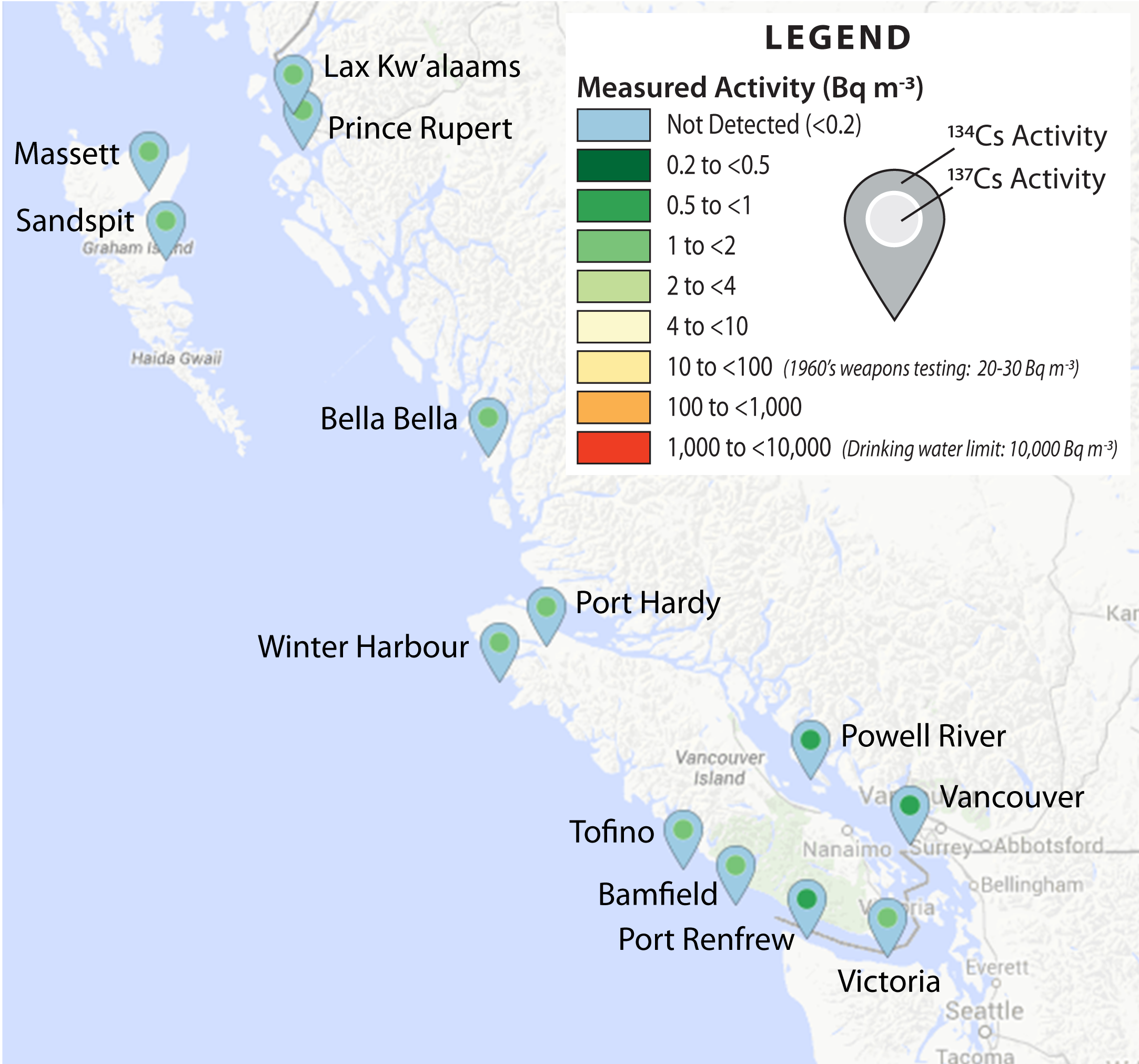
InFORMal monitoring results from samples collected in February and March 2015

Results* from early February and March are now available from 10/13 of the InFORM sampling locations. Recent samples from Bamfield, Vancouver, and Powell River are still being processed. To date, no InFORM coastal samples have detectable (detection limit ~0.2 Bq m-3) levels of 134Cs, the radionuclide that is the fingerprint of Fukushima derived radiation due to its short half life (~2 years). An interesting note is that the February Tofino sample was collected on the 7th, just 12 days before the ORO sample collected in Ucluelet that was the first to contain measureable 134Cs. Continue reading April 2015 InFORMal Monitoring Update

Fukushima Contamination Detected at Shoreline in British Columbia

Satellite measurements of ocean temperature (illustrated by color) and the direction of currents (white arrows) help show where radionuclides from Fukushima are transported. Large scale currents transport water westward across the Pacific. Circles indicate the locations where water samples were collected. White circles indicate that no cesium-134 was detected. Blue circles indicate locations were low levels of cesium-134 were detected. Small amounts of cesium-134 have been detected in a water sample taken Feb. 19, 2015, from a dock in Ucluelet, British Columbia. (Woods Hole Oceanographic Institution)


The purpose of this post is to report that for the first time ocean borne contamination from Fukushima has been detected at the shoreline in British Columbia representing the first landfall in North America. Citizen scientists collected the sample on February 19, 2015 in the town of Ucluelet on the west coast of Vancouver Island Canada as part of our partner program Our Radioactive Ocean out of Woods Hole Oceanographic Institution in the USA. The isotope Cesium-134 (134Cs half life ~2 years) is an unequivocal fingerprint of Fukushima derived contamination because all other sources of this man made isotope (principally the Chernobyl disaster in 1986) are far enough in the past that 134Cs has long since decayed to levels too low to detect today. The Ucluelet sample contained 134Cs at 1.4 Becquerel per cubic meter (Bq m-3) of seawater and 5.8 Bq m-3 of the longer lived 137Cs (half life ~30 years). These levels were expected given measurements made by monitoring programs offshore and modeling studies which predict the arrival time and activity of Fukushima radionuclides. These levels of 137Cs and 134Cs, are well below internationally established levels that might represent a danger to human or environmental health. The next number of months will be very important to track the ocean transport of the contamination as citizen scientists with Our Radioactive Ocean and the InFORM project continue to collect samples up and down the coast of North America. Continue reading Fukushima Contamination Detected at Shoreline in British Columbia

March 2015 InFORMal Monitoring Update

March2015 w Labels
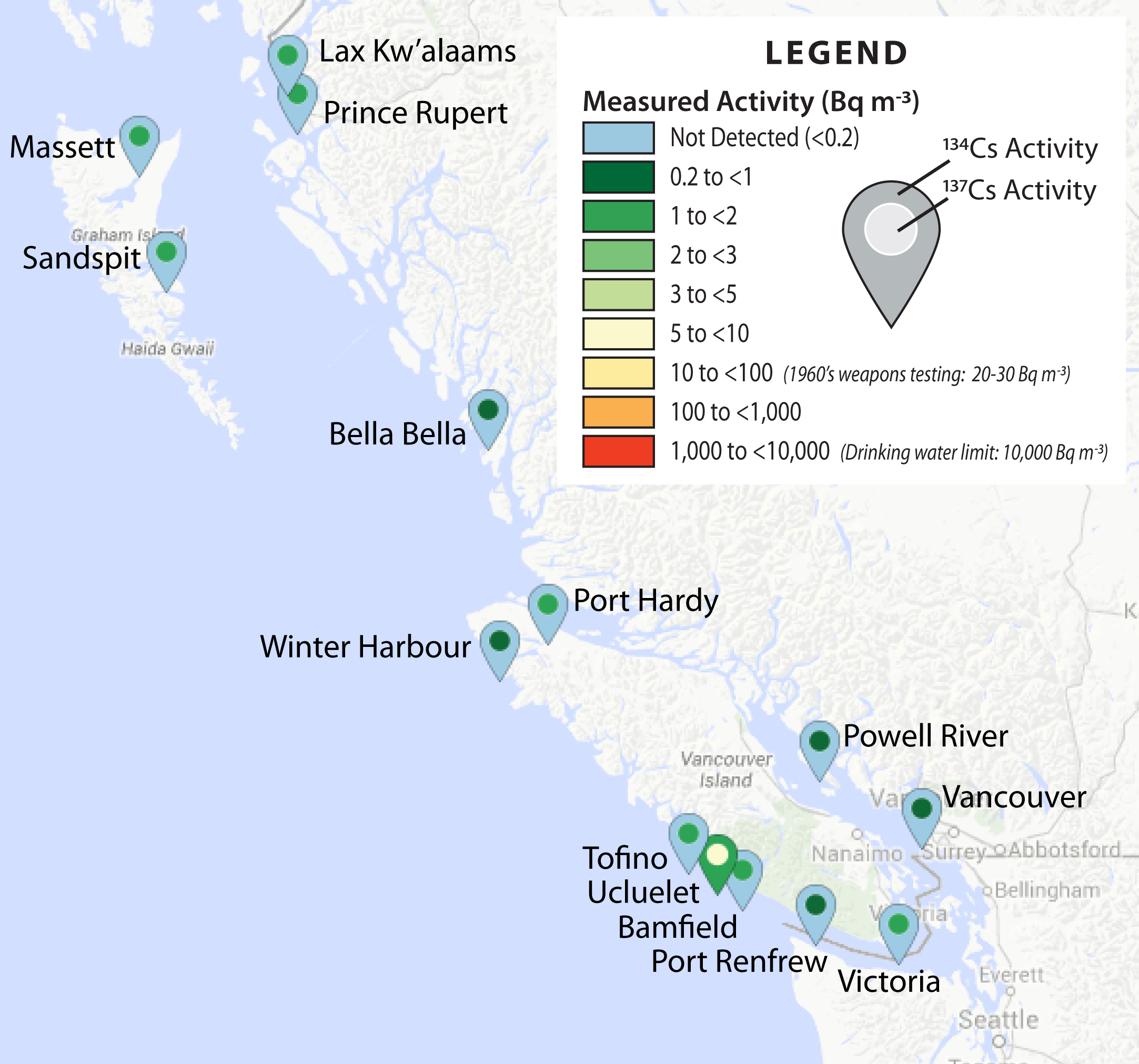
InFORMal scientist monitoring results from January and February 2015

Forty water samples have been collected between October 2014 and March 2015 from 13 communities along the British Columbia coast. Results* from 19 samples are currently available.

Continue reading March 2015 InFORMal Monitoring Update