January 2016 InFORMal Monitoring Update



By Jay T. Cullen
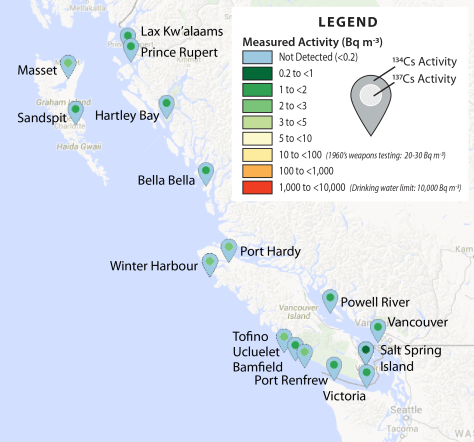
The purpose of this diary is to report the most recent results of Kelp Watch 2015, a program dedicated to monitoring for Fukushima derived contamination along the Pacific Coast of North America. New results from the fourth sampling period (May 4 through June 10 2015) were released on Dec. 8, 2015 and can be found here. As with previously reported results here, here, here and here no radioactive isotopes from Fukushima were detected in kelp growing at sampling sites along our Pacific coast. The absence of 134Cs in kelp suggests that ocean transport of Fukushima contamination had yet to reach persistently high enough levels in North American coastal water to bioaccumulate in kelp. The scientific community expects that levels of contamination rise in coastal waters as predicted by measurements and models in the coming year Kelp Watch 2015 will help to track the arrival of the plume in time and space. Continue reading KelpWatch 2015 Monitoring: No Fukushima derived contamination May – June ’15
By Jay T. Cullen
Previously unpublished data results from research expeditions in 2014 and 2015 are summarized here. Overall the data indicate that:
By Jonathan Kellogg and Jay T. Cullen


Results from surface water samples collected in August 2014 during three oceanic research cruises are now available. These seawater samples were analyzed to characterize the distribution of Fukushima derived radionuclides 137-Cesium (137Cs half life ~30 years), and 134-Cesium (134Cs half life ~2 years). Based on the distribution of 134Cs, the Fukushima plume was not consistently present yet on the BC coast. It is likely that peak concentrations of radiocesium will be present offshore in the next year.
Continue reading Summer 2014 Offshore Monitoring for Fukushima Contamination
 Home
Home 