Tag Archives: Salmon

Coho Salmon Returning to the Quinsam River on Vancouver Island

By Jay T. Cullen

Eiko Jones is a photographer who specializes in underwater imaging and works out of Campbell River on Vancouver Island in British Columbia. He recently completed a project where he captured a lengthy, high definition video of coho salmon (Oncorhynchus kisutch) returning to the Quinsam River.

You can read about the technical details of the shoot at Eiko’s blog if you are interested. The video shows these amazing fish completing their life cycle by returning to the natal river to spawn.  Our monitoring project has been collecting coho, other Pacific salmon and marine organisms to look for Fukushima radionuclide contamination and to determine the impact of the disaster on ecosystem and public health.

Enjoy Eiko and his teams work below.

Contamination of freshwater fish by the Fukushima Nuclear Accident: Overview of monitoring results

By Jay T. Cullen

Adult Oncorhynchus mykiss or rainbow trout. One of the species monitored for Fukushima derived radionuclides in the Wada et al. (2015) study.

The purpose of this post is to report the results of a monitoring study looking for Fukushima Dai-ichi Nuclear Power Plant (FDNPP) derived contamination in freshwater fishes in Japan.  The peer reviewed study by Wada and colleagues was recently published in Journal of Environmental Radioactivity which is unfortunately behind a publisher paywall.  This post continues a series of posts aimed at communicating the results of scientific investigations of the impact of the FDNPP disaster on public and environmental health.  Wada and colleagues measured the amount of 131-Iodine (131I half life ~ 8 days), 134-Cesium (134Cs half life ~2 years), and 137-Cesium (137Cs half life ~30 years) in freshwater fish species collected from rivers, lakes and aquaculture ponds in Fukushima Prefecture between March 2011 and December 2014.  A total of 16 species and 2692 individual fish were examined.  Between March and June 2011 11 fish were found to have detectable but low activities of 131I (<25 Bq kg-1 wet weight) suggesting that radioactive iodine did not accumulate significantly in fish.  Continue reading Contamination of freshwater fish by the Fukushima Nuclear Accident: Overview of monitoring results

Update: Monitoring Results For Sockeye Salmon and Steelhead Trout Collected Summer 2014

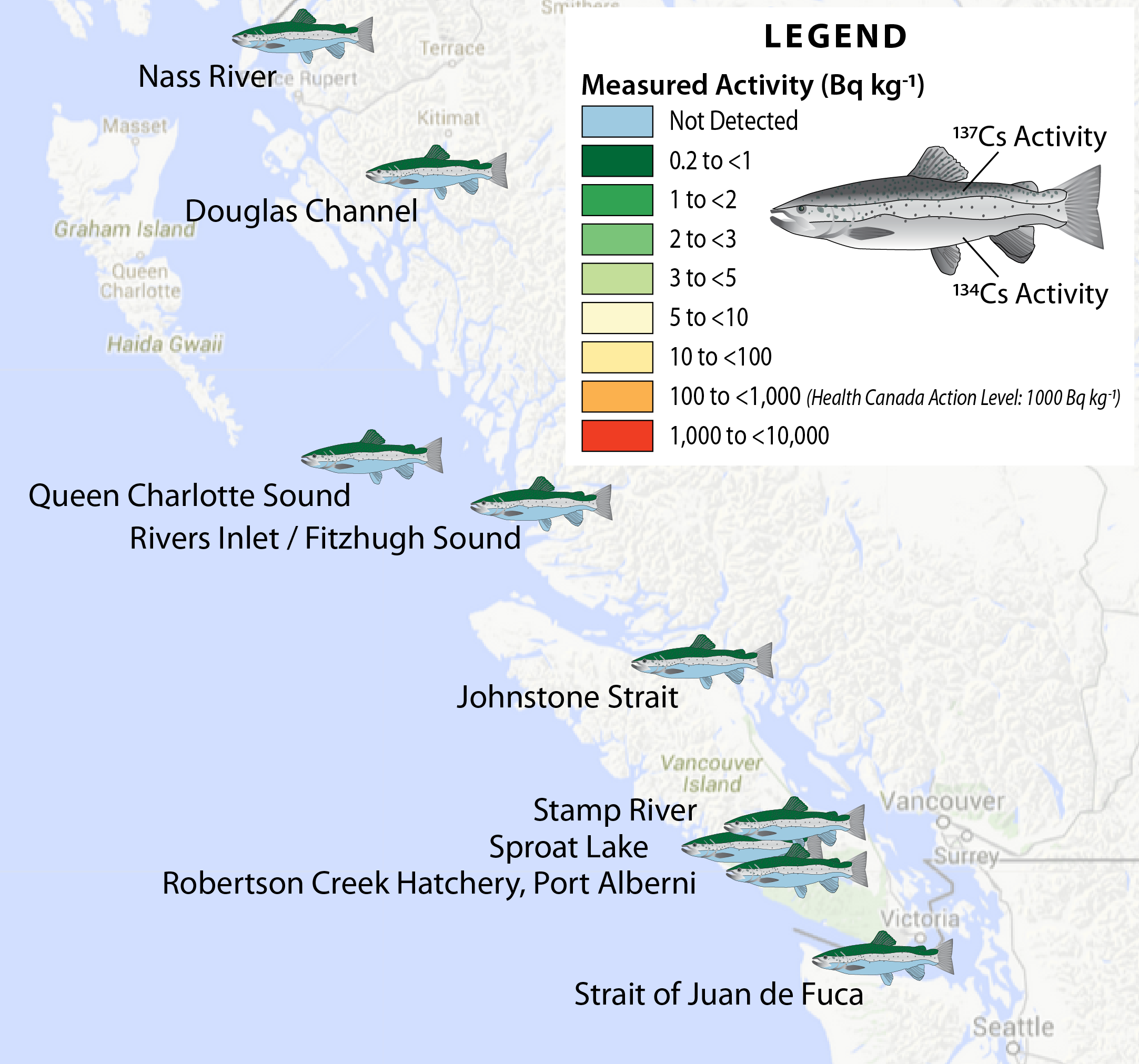
Summary of the amount of radioactive cesium isotopes in sockeye salmon and steel head trout harvested from BC waters in 2014 (Figure by Jonathan Kellogg jkellogg@uvic.ca).

The measurements undertaken as part of the InFORM project to look for Fukushima derived radionculides in fish during our first of three years of monitoring are now complete. Sockeye salmon (Oncorhynchus nerka) and Steelhead Trout (Oncorhynchus mykiss) (as well as some Chinook, Chum and Pink Salmon) were caught off the west coast of Canada in Summer 2014 as they were returning to 9 different streams and rivers up and down the coast of British Columbia Canada. These results add to the first 19 fish which we reported on in December of 2014.

Continue reading Update: Monitoring Results For Sockeye Salmon and Steelhead Trout Collected Summer 2014

Health Canada/InFORM Analyses of the Radioactive Content of Fish Samples from Canada’s West Coast

This page mirrors information on the radionuclide content of fish measured by Health Canada and the InFORM project that can be found at Open Government, Open Data.

Continue reading Health Canada/InFORM Analyses of the Radioactive Content of Fish Samples from Canada’s West Coast

Scientific Study of Radioactive Cesium Accumulation by Salmon

By Jay T. Cullen

@JayTCullen and @FukushimaInFORM

Male spawning phase Oncorhynchus nerka. When landlocked (freshwater phase) this sockeye salmon is referred to as kokanee.


The purpose of this post is to report a recently published study (behind pay wall) that examined how and how much radioactive cesium is accumulated by salmonids (e.g. salmon and trout). This post is part of an series started in 2013 to communicate the results of scientific research into the impact of the Fukushima Dai-ichi triple meltdowns on the environment. Yamamoto and colleagues carried out two experiments (one lake cage experiment and a laboratory experiment) to examine the accumulation of radiocesium from water and food by kokanee (Oncorhynchus nerka) and masu salmon (Oncorhynchus masou). The conclusions of the study were as follows:

Continue reading Scientific Study of Radioactive Cesium Accumulation by Salmon