
Shaw TV’s journalist Rajie Kabli interviews Lucas Harris of Surfrider Vancouver Island, a local partner organization that likes to ride the waves, and keep the beaches clean. Lucas and his organization are helping InFORM to coordinate with citizen scientists in the South Island area to monitor for Fukushima derived radioisotopes in coastal waters. Check them out here. Thanks to Rajie for here interest in our project.
Tag Archives: Fukushima
Plutonium Inventories at Fukushima Dai-ichi Nuclear Power Plant and Mixed Oxide (MOX) Fuel at Unit 3
The purpose of this post is to provide estimates of the plutonium (Pu) isotopes present at the Fukushima Dai-ichi nuclear power plant (NPP) at the beginning of the disaster in March 2011. The post is part of an ongoing effort to communicate facts about Fukushima obtained through scientific study of the impact of the meltdowns on the environment. Comments on this site and in other public forums highlight the fact that Unit 3 at the NPP was burning mixed oxide (MOX) fuel at the time of the accident which, because it is enriched in Pu, suggests that these releases are potentially more harmful. Here I report estimates of Pu present in the reactors (Units 1, 2 and 3) and spent fuel pools (Units 1-4) at the site based on burnup calculations. Because fission of low enriched uranium (LEU) fuel produces Pu isotopes during operation there was a significant amount of Pu on site in Units 1-4. During extended operation a MOX fuel burning reactor can produce multiple times the Pu of LEU but this was not so at the time of the Fukushima meltdowns. The amount of additional Pu present due to Unit 3’s MOX fuel is small compared to the other reactor cores and the inventory of the spent fuel pools. The differences between environmental impact of MOX versus LEU reactor core meltdown in this case are small. Estimates of the release of Pu isotopes from Fukushima, based on measurements of air, soil and water suggest 100,000 fold less was broadcast to the environment compared to Chernobyl and 5,000,000 fold lower than releases from nuclear weapons testing in the 20th century. Continue reading Plutonium Inventories at Fukushima Dai-ichi Nuclear Power Plant and Mixed Oxide (MOX) Fuel at Unit 3
Comparing the Environmental Impacts of the Chernobyl and Fukushima Disasters

This post reports on a recently published peer reviewed study by Steinhauser and colleagues in the journal Science of the Total Environment (behind pay wall) comparing the Chernobyl and Fukushima nuclear accidents. The post is part of an ongoing effort to communicate the results of scientific studies into the impact of the Fukushima disaster on the environment. A majority of the radioactivity released from both Chernobyl and Fukushima can be attributed to volatile radionuclides (noble gases, iodine, cesium, tellurium). In contrast, the amounts of more refractory elements (including actinides like plutonium), released by Chernobyl was ~four orders of magnitude (10,000 fold) higher than releases from Fukushima. The most cited source term for Chernobyl is 5300 PBq (excluding noble gases) while a review of published studies of Fukushima carried out by the authors above allow an estimate for the total atmospheric source term of 520 (a range of 340–800) PBq. Monitoring of air, soil and water for radionuclides after the respective accidents indicate that the environmental impact of Chernobyl is likely to be much greater than the Fukushima accident. The post is relatively information dense as I have provided data tables for those who are interested in the estimates and the peer-reviewed studies from which they come. Apologies up front to those who find such information tedious. Continue reading Comparing the Environmental Impacts of the Chernobyl and Fukushima Disasters
Most Recent Measurements of Fukushima Derived Isotopes in the Northeast Pacific Ocean
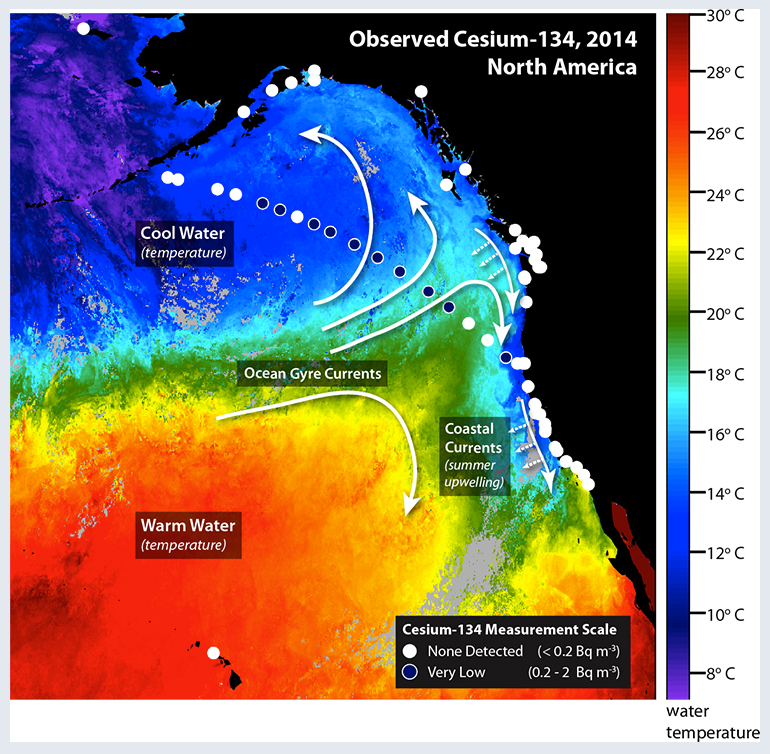
The purpose of this post is to report on new results coming out the crowd-funded Our Radioactive Ocean program headed up by Dr. Ken Buesseler of Woods Hole Oceanographic Institution. This post is part of an ongoing series dedicated to scientific inquiry into the impact of the triple meltdowns at Fukushima on the health of the North Pacific Ocean and residents of the west coast of North America. Measurements of the cesium radioisotopes 134-Cs (half life ~ 2 years) and 137-Cs (half life ~30 years) were made on samples collected on a transect between Monterey Bay CA and Dutch Harbor AK this summer. Because of its relatively short half life 14-Cs serves as an unequivocal tracer of Fukushima contamination in the environment. Fukushima derived 134-Cs was detected at offshore stations with a maximum activity of ~ 2 Bq/m^3 and total 137-Cs activities of ~7 Bq/m^3 of seawater. Measurements have yet to detect 134-Cs in nearshore waters sampled up and down the North American west coast. These activities of Cs are orders of magnitude below levels thought to pose a measurable risk to human health or marine life, according to international health agencies.
For a primer on radioactivity in the ocean and the units used to discuss radioactive elements in the environment please visit this post.
A press release from WHOI regarding these new results can be found here and details about sampling locations and activities of Cs detected are available here.
At a great majority of sites sampled along the coast and offshore the activity of 134-Cs is below detection limit (~legacy contamination resulting from atmospheric weapons testing in the 20th century. Similar to previous work by Dr. John Smith of the Department of Fisheries and Oceans Canada the presence of the contaminated plume of seawater owing to releases from Fukushima can be detected in offshore stations (150 – 1500 km) with levels of 134-Cs approaching 2 Bq/m^3 and total 137-Cs (bomb + Fukushima) of about ~7 Bq/m^3. These levels of 137-Cs are similar to levels in the North Pacific Ocean that were present in 1990 owing to the combined effects of Chernobyl and weapons testing fallout as shown in the figure below.

Activities of these isotopes were about 10 million fold higher in coastal waters near the Fukushima Dai-ichi nuclear power plant off Japan in the weeks following the beginning of the disaster in March and April 2011 when rates of release and seawater concentrations were at their peak. Current releases from the plant support seawater activities on the order of 10’s-100’s of Bq/m^3 within 2 km of the plant site. The highest activities associated with the most contaminated seawater from Fukushima are predicted to travel across the North Pacific with prevailing currents and arrive in North American waters between this year and next. These offshore activities of Fukushima derived 137-Cs of ~ 5 Bq/m^3 exceed predicted activities of ~3 Bq/m^3 suggesting that offshore activities are likely reaching near peak values. The measurements being made by the international scientific community will undoubtedly help to improve our understanding of mixing and transport in the oceans.
The activities of radiocesium being detected offshore are well below levels thought to represent significant radiological health risks to marine organisms or residents of the west coast of North America. To this point no 134-Cs from the contaminated plume approaching the coast has been detected in nearshore waters. Ongoing monitoring by programs like Our Radioactive Ocean and its partner program InFORM which are making measurements of contamination in seawater and marine organisms will be key to understanding impacts of the Fukushima on our environment.
Error in Study Suggests Fukushima Releases Greater Than Chernobyl

The purpose of this post is to address an error in a recently published review of current release estimates from the Fukushima Dai-ichi nuclear power plant disaster that began in March 2011. The post is part of an ongoing effort to communicate results of scientific studies aimed at understanding the impact of Fukushima on the health of the North Pacific and residents of the west coast of North America. In a recent review paper published in Progress in Nuclear Energy by Koo and colleagues this July, compiled estimates of atmospheric and ocean releases from Fukushima were presented. Due to an error in interpretation they suggest that direct ocean releases were a factor of 4 greater than atmospheric releases of radiologically significant isotopes like 131-I (~8 day half life) and 137-Cs (~30 year half life). This error inflates release estimates and has been reported on to suggest Fukushima releases exceed Chernobyl’s. Accurate estimates of releases from Fukushima suggest that they are about an order of magnitude less than those from Chernobyl in 1986.
The study of Koo and others (link to a ResearchGate upload) estimated atmospheric releases of 131-I, 137-Cs and the noble gas 133-Xe (half life ~ 5 days) from the Fukushima Dai-ichii nuclear power plant. Their estimates compared with previously published estimates are reported in the following table (Table 2 from paper):

Similar to previous work, for example, they estimate the atmospheric release of 137-Cs from the plant to be 10-50 PBq or somewhere between 3 and 17 kg of the isotope. Given the core inventories of reactors 1-3 this release represents about 4% of the inventory at the time of the meltdowns in March 2011.
The authors make a significant error when they begin their estimate of direct releases from Fukushima to the ocean when they state the following in section 2.2.2. Release from the primary system into the sea:
It is reported that, of the total radioactivity released from the units 1–3 into the environment, more than 80% of it flowed into the sea (Hoeve and Jacobson, 2012 and Christoudias and Lelieveld, 2013), implying that 4 times more radioactivity was released to the sea than to the atmosphere.
Bolds are mine. In stating that 80% of the total radioisotope releases flowed into the sea they fundamentally misinterpret the studies they cite. What the study of Christoudias and Lelieveld (2013), and other studies not referenced here in the diary, actually show and establish is that (quoting from the Christoudias and Lelieveld work):
We calculated that about 80% of the radioactivity from Fukushima which was released to the atmosphere deposited into the Pacific Ocean.
This is a fundamentally different than the interpretation Koo and colleagues use in their study. By wrongly interpreting that atmospheric releases represent 20% of the total release they assume that direct ocean releases are 4 fold greater than the 4% of core inventories (10-50 PBq) or 16% of core inventories of 137-Cs in March 2011. This error greatly increases the estimated total releases from the plant (atmosphere + direct ocean).
It is very likely that this incorrect approach will lead others to conclude that total releases from Fukushima are greater than those from Chernobyl. For example a back of the envelope calculation assuming the 4% of the total core inventory of 137-Cs (760-820 PBq according to the table above) was released to the atmosphere and 16% to the ocean would lead to a total release of ~152-164 PBq. Such a calculation was done by a popular news aggregator and editorial site that has a history of misinterpreting and misinformation the public about Fukushima. This estimate, not surprisingly, is at great odds with existing estimates based on measurements and modeling.
Best estimates to date suggest that:
1. atmospheric releases of 137-Cs were 19.4 +- 3.0 PBq through the end of March 2011
2. direct ocean discharge of 137-Cs to the Pacific in addition to atmospheric deposition are in the range 2.3 to 26.9 PBq
3. About 19.5 +- 5% of releases were deposited to land while about 80% ended up in the Pacific Ocean
A report reviewing the most recent peer reviewed studies which reaches these conclusions was summarized in a post here.
Releases of isotopes that represent potential radiological health threats given their respective total activities and/or their significant half lives (e.g. 131-I and 137-Cs) were about an order of magnitude (factor of 10 times) lower than the releases from the Chernobyl disaster in 1986 (see reports here and here for example). More and more observations are being made globally by the international scientific community which will help to improve source term and release estimates. I will report on these studies as the data becomes available.
I have contacted the authors to bring their attention to this problem with their study.
 Home
Home 