
Tag Archives: Citizen Science

CBC News: Fukushima nuclear pollution hasn’t hit B.C. shore, says researcher Jay Cullen

Cullen expects nuclear pollution from Fukushima will hit B.C.’s beaches eventually

By Daybreak North, CBC News Posted: Mar 11, 2015 3:33 PM PT Last Updated: Mar 11, 2015 9:57 PM PT

Ocean currents act as a conveyor, carrying debris and radiation-contaminated water from Japan towards North America. Ocean currents act as a conveyor, carrying debris and radiation-contaminated water from Japan towards North America. (NOAA)

Four years after a massive earthquake struck Japan, creating a nuclear disaster in Fukushima, research shows nuclear pollution is making its way towards B.C., but isn’t affecting fish.

“According to all the measurements that we’ve made thus far, and with our partner Health Canada who have been making measurements of fish since 2011, we’ve yet to detect that marker isotope for fish caught along the coast,” Jay Cullen, a University of Victoria professor, told Daybreak North’s Carolina de Ryk.

The earthquake that struck off the coast of the Tohoku region in northeastern Japan on March 11, 2011, set off a monster wave, up to seven metres high, that crashed over the coast, causing massive damage.

The seawater from the tsunami breached the Fukushima Daiichi nuclear plant, disabling its cooling system, causing a nuclear meltdown that the country is still trying to clean up. Altogether, the disaster killed 19,000 people and displaced more than 300,000.

Cullen, who leads a network to monitor the impact of the nuclear pollution caused by the disaster, said his team is looking for two specific cesium isotopes released from Fukushima.

“Atmospheric fallout reached the BC coast in the weeks following the meltdowns according to Health Canada monitoring stations. Transport by prevailing ocean currents was detected as early as 2012 about 1,500 kilometres offshore, and in 2014 we were detecting that contamination — fingerprint element that could only come from Fukushima on the continental shelf of British Columbia,” he said.

The team he works with is also analyzing samples sent in by residents along B.C.’s coast, which he said haven’t turned up any trace of Fukushima radiation.

He expects the nuclear pollution will hit B.C.’s beaches eventually, and he said researchers like himself will continue to monitor the impact that will have.
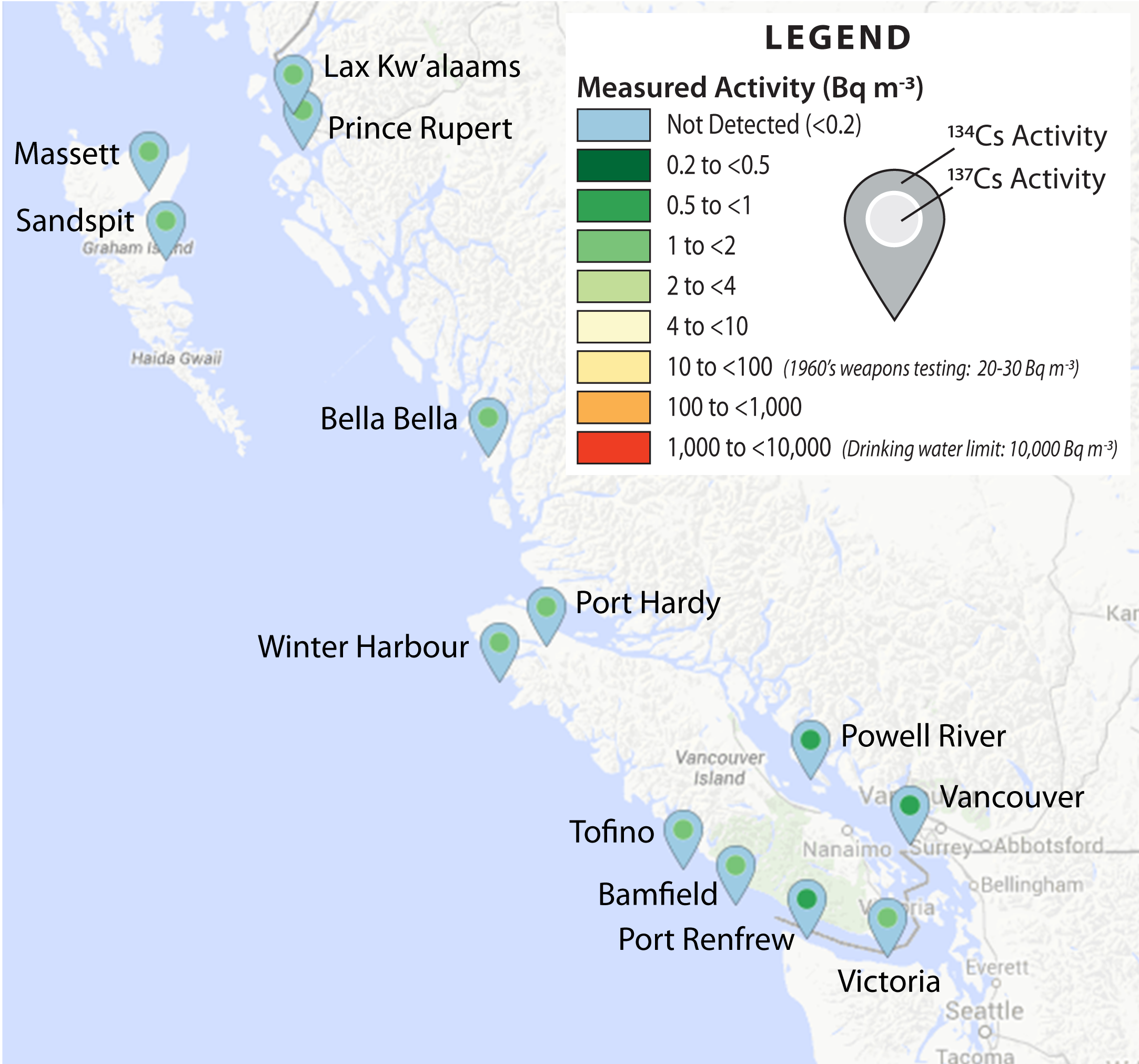
 

March 2015 InFORMal Monitoring Update

March2015 w Labels
InFORMal scientist monitoring results from January and February 2015

Forty water samples have been collected between October 2014 and March 2015 from 13 communities along the British Columbia coast. Results* from 19 samples are currently available.

Continue reading March 2015 InFORMal Monitoring Update

Prince Rupert Citizen Science Monitoring Continues for February 2015

Feb. 19, 2015

Prince Rupert BC

Prince Rupert’s third sample was recently collected by our volunteer team including students from NWCC Desiree Louis (College and Career Prep program) and Michael Standbridge (Applied Coastal Ecology (ACE) program). Sampling is being coordinated by Cheryl Paavola (Instructor and Science Lab Tech) at Northwest Community College – Prince Rupert.

This slideshow requires JavaScript.

Continue reading Prince Rupert Citizen Science Monitoring Continues for February 2015

More Citizen Science Seawater Monitoring Results: No Fukushima Contamination Detected

By Jay T. Cullen

@JayTCullen and @FukushimaInFORM

February 16, 2015

What we found:

The absence of any detectable 134-Cs (an unambiguous fingerprint isotope of Fukushima contamination) in the seawater samples indicates that as of November 2014 these locations covering the length of the British Columbia coast have not be affected by ocean currents carrying Fukushima contamination.

The detection limit for 134-Cs averages ~0.2 Bq m-3

Newly added results come from seawater samples collected in collaboration with citizen scientists at the following locations in British Columbia, Canada during November 2014.

  1. Bamfield
  2. Masset, Haida Gwaii
  3. Lax Kw’alaams

Samples were processed and the amount of gamma emitting isotopes determined using a high purity germanium detector.  We look primarily for radioisotopes of cesium (134-Cs half life ~2 years and 137-Cs half life ~ 30 years) for the following reasons:

  1. 134-Cs has a half life that is short enough that all other human sources to the environment have decayed away making it an ideal tracer for Fukushima contamination
  2. next to the short lived Iodine-131 (half life ~ 8 days), Cs isotopes were released in greatest activity to the environment from Fukushima and would be most likely to represent a radiological health risk given their chemistry and propensity to be taken up by the biota
  3. other isotopes were released in much lower amounts from Fukushima relative to Cs (see other posts here and search for plutonium and strontium for example) and would therefore be much more difficult to detect
  4. because they are gamma emitters (unlike Pu isotopes and 90-Sr which emit alpha and beta radiation respectively) they are relatively easy and resource efficient to detect

The absence of detectable 134-Cs indicates that waters near these locations spanning the length of British Columbia have not been contaminated with Fukushima radioactive elements transported across the Pacific by prevailing currents as of Nov 2014. The presence of 137-Cs is due to historical sources of this human made isotope owing to atmospheric nuclear weapons tests in the 20th century and contamination from the Chernobyl disaster in 1986. You can read about the levels of 137-Cs in the North Pacific pre-Fukushima here.

More results will be published as they become available.