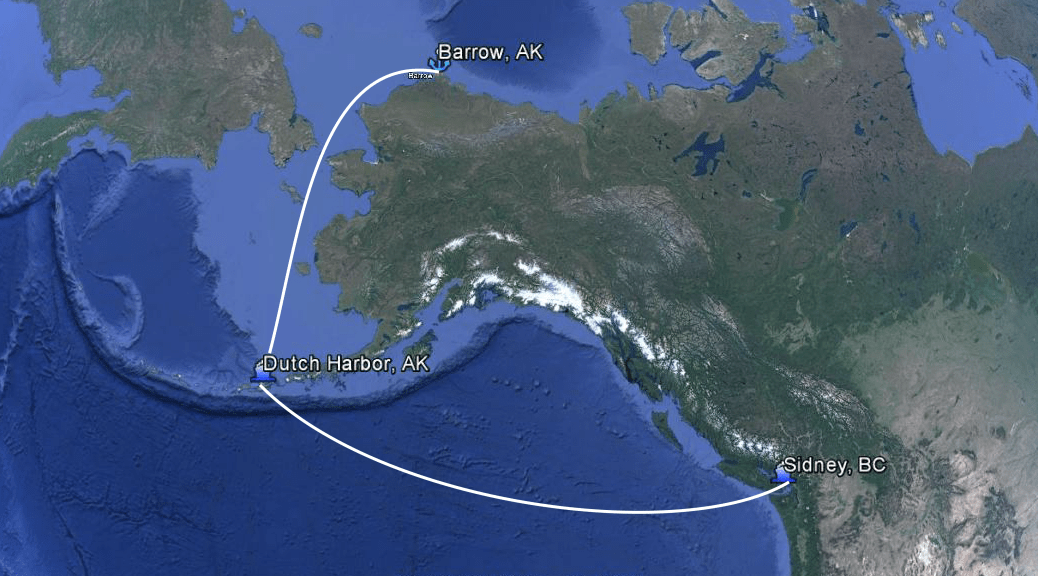
Less than half a year ago, I had absolutely no idea I would be spending three weeks at sea this summer. Now, it is only a few days before I will be aboard the CCGS Sir Wilfrid Laurier collecting surface sea water samples and processing them as part of the Fukushima InFORM project. In doing so, I am continuing the work of two other undergraduates who have been part of the monitoring efforts – Laura and Kathryn.
the CCGS Sir Wilfrid Laurier at Ogden Point
All Aboard!
Saskia Kowallik at her lab bench where she’ll be spending oodles of time over the next three weeks.
by Goldschmidt Conference
Originally published by EurekAlert
26 June 2016
New research shows that most of the radioactive fallout which landed on downtown Tokyo a few days after the Fukushima accident was concentrated and deposited in non-soluble glass microparticles, as a type of ‘glassy soot’. This meant that most of the radioactive material was not dissolved in rain and running water, and probably stayed in the environment until removed by direct washing or physical removal. The particles also concentrated the radioactive caesium (Cs), meaning that in some cases dose effects of the fallout are still unclear. These results are announced at the Goldschmidt geochemistry conference in Yokohama, Japan. Continue reading Most radioactive caesium fallout on Tokyo from Fukushima accident was concentrated in glass microparticles→
by National Academies of Sciences, Engineering, and Medicine
Published by EurekAlert! on 20 May 2016
The Phase 2 report from the National Academies focuses on three issues: (1) lessons learned from the accident for nuclear plant security, (2) lessons learned for spent fuel storage, and (3) reevaluation of conclusions from previous Academies studies on spent fuel storage.
The 2011 Fukushima Daiichi nuclear accident should serve as a wake-up call to nuclear plant operators and regulators on the critical importance of measuring, maintaining, and restoring cooling in spent fuel pools during severe accidents and terrorist attacks, says a new report from the National Academies of Sciences, Engineering, and Medicine. This report is the second and final phase of a congressionally mandated study on what lessons can be learned from the Fukushima Daiichi nuclear accident. The report from Phase 1 of this study was released in July 2014. The Phase 2 report provides findings and recommendations for improving U.S. nuclear plant security and spent fuel storage as well as re-evaluates conclusions from previous Academies studies on spent fuel storage safety and security.
[Links to the Phase 1 and Phase 2 reports are available under the Resources menu.]



 by Goldschmidt Conference


 Home
Home 