November 2014 sampling for the InFORM projects was carried out by volunteers from our NGO partner Surfrider Foundation Vancouver Island. If you love the ocean you will love Surfrider. Port Renfrew is located on the southwest coast of Vancouver Island. Port Renfrew is in the traditional territory of the Pacheedaht (meaning “people of the sea foam”) First Nation. Port Renfrew is the southern terminus of the West Coast Trail and is close to some of the biggest trees in Canada and in the world.
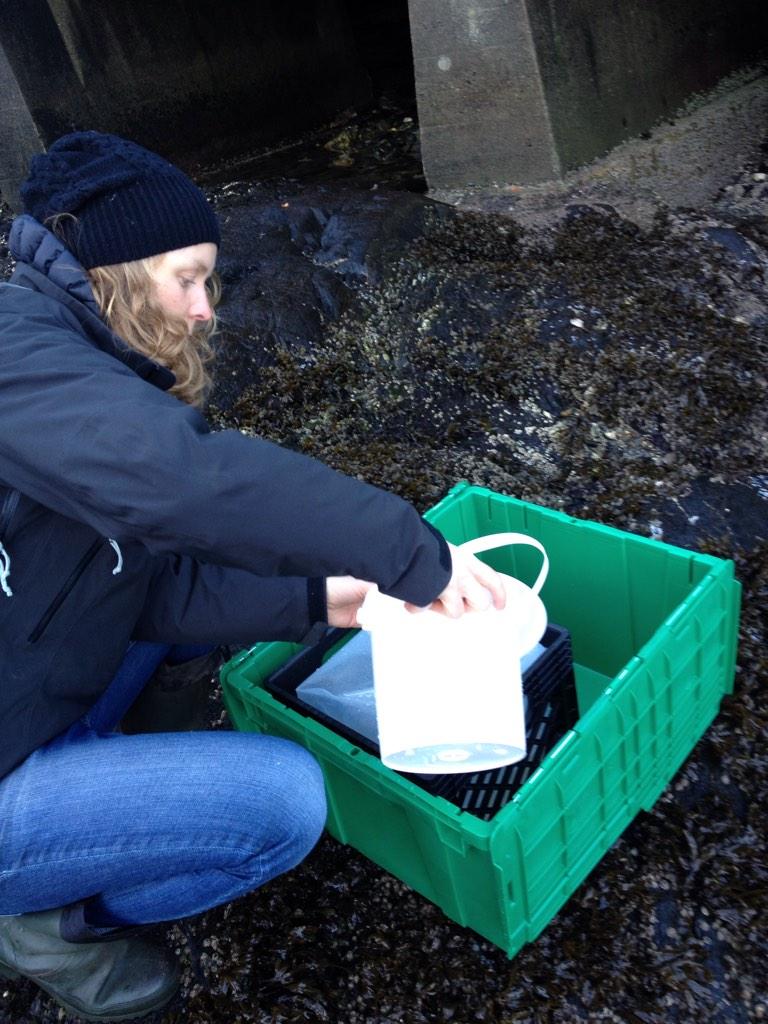
The picture below shows the first InFORM sample in Port Renfrew being collected in November 2014.
The following description was taken from the Cape Scott – Winter Harbour Cottages website which can be found here.
Winter Harbour BC is on the northwest coast of Vancouver Island, 75 kilometres (gravel road) west of Port Hardy. Approximately a 5 hour drive from Campbell River. Winter Harbour is also accessible by water, via Quatsino Sound, from Coal Harbour or Port Alice.
In the 1930’s Winter Harbour was settled as a remote fishing community for west coast trollers. Having survived the ups and downs of the commercial fishing fleet, the village has evolved into a popular sports fishing destination. Fifteen minutes by speed boat puts fishers onto productive ocean fishing grounds. Salmon and bottom fish abound offshore as well as in the sheltered waters of Quatsino Sound.
Winter Harbour is close to many wild, west coast beaches and hiking trails. Within the village, an historic boardwalk leads through the forest and along the shore. Nearby, Botel Park offers a rainforest hike from the community to an outside shore.
Here is a picture of the InFORM sampling kit on the dock in Winter Harbour ready to be filled with seawater and returned to UVic for processing and later analysis. Results will be reported as they become available.
InFORM sampling kit dwarfed by the M/V Raw Spirit at the dock in Winter Harbour, BC Nov. 2014.
Winter Harbour’s location is indicated on the map below and more information about the settlement can be found here>
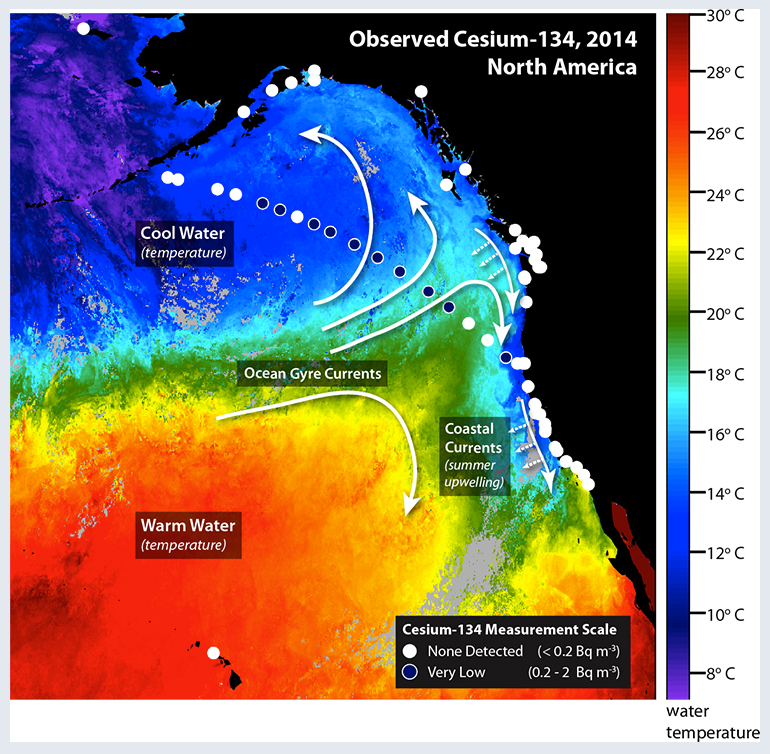
Satellite measurements of ocean temperature (illustrated by color) from July 28th to August 4th and the direction of currents (white arrows) help show where radionuclides from Fukushima are transported. Large scale currents transport water westward across the Pacific. Upwelling along the west coast of North America in the summertime brings cold deep water to the surface and transports water offshore. Circles indicate the locations where water samples were collected. White circles indicate that no cesium-134 was detected. Blue circles indicate locations were low levels of cesium-134 were detected. No cesium-134 has yet been detected along the coast, but low levels have been detected offshore. (Woods Hole Oceanographic Institution)
The purpose of this post is to report on new results coming out the crowd-funded Our Radioactive Ocean program headed up by Dr. Ken Buesseler of Woods Hole Oceanographic Institution. This post is part of an ongoing series dedicated to scientific inquiry into the impact of the triple meltdowns at Fukushima on the health of the North Pacific Ocean and residents of the west coast of North America. Measurements of the cesium radioisotopes 134-Cs (half life ~ 2 years) and 137-Cs (half life ~30 years) were made on samples collected on a transect between Monterey Bay CA and Dutch Harbor AK this summer. Because of its relatively short half life 14-Cs serves as an unequivocal tracer of Fukushima contamination in the environment. Fukushima derived 134-Cs was detected at offshore stations with a maximum activity of ~ 2 Bq/m^3 and total 137-Cs activities of ~7 Bq/m^3 of seawater. Measurements have yet to detect 134-Cs in nearshore waters sampled up and down the North American west coast. These activities of Cs are orders of magnitude below levels thought to pose a measurable risk to human health or marine life, according to international health agencies.
For a primer on radioactivity in the ocean and the units used to discuss radioactive elements in the environment please visit this post.
A press release from WHOI regarding these new results can be found here and details about sampling locations and activities of Cs detected are available here.
At a great majority of sites sampled along the coast and offshore the activity of 134-Cs is below detection limit (~legacy contamination resulting from atmospheric weapons testing in the 20th century. Similar to previous work by Dr. John Smith of the Department of Fisheries and Oceans Canada the presence of the contaminated plume of seawater owing to releases from Fukushima can be detected in offshore stations (150 – 1500 km) with levels of 134-Cs approaching 2 Bq/m^3 and total 137-Cs (bomb + Fukushima) of about ~7 Bq/m^3. These levels of 137-Cs are similar to levels in the North Pacific Ocean that were present in 1990 owing to the combined effects of Chernobyl and weapons testing fallout as shown in the figure below.
Activity of 137-Cs in the North Pacific after Povinec and others (2013) http://www.biogeosciences.net/10/5481/2013/bg-10-5481-2013.html with arrows indicating the impact of Chernobyl, 2008 137-Cs activity in the Irish Sea and 2014 levels offshore of western North America post Fukushima for comparison.
Activities of these isotopes were about 10 million fold higher in coastal waters near the Fukushima Dai-ichi nuclear power plant off Japan in the weeks following the beginning of the disaster in March and April 2011 when rates of release and seawater concentrations were at their peak. Current releases from the plant support seawater activities on the order of 10’s-100’s of Bq/m^3 within 2 km of the plant site. The highest activities associated with the most contaminated seawater from Fukushima are predicted to travel across the North Pacific with prevailing currents and arrive in North American waters between this year and next. These offshore activities of Fukushima derived 137-Cs of ~ 5 Bq/m^3 exceed predicted activities of ~3 Bq/m^3 suggesting that offshore activities are likely reaching near peak values. The measurements being made by the international scientific community will undoubtedly help to improve our understanding of mixing and transport in the oceans.
The activities of radiocesium being detected offshore are well below levels thought to represent significant radiological health risks to marine organisms or residents of the west coast of North America. To this point no 134-Cs from the contaminated plume approaching the coast has been detected in nearshore waters. Ongoing monitoring by programs like Our Radioactive Ocean and its partner program InFORM which are making measurements of contamination in seawater and marine organisms will be key to understanding impacts of the Fukushima on our environment.
Distribution of soil activity concentration due to 134Cs and 137Cs within 80 km of the Fukushima Daiichi nuclear power plant. Considering radioactive decay, the activity concentrations in the graph were corrected to July 2, 2011 From Koo et al. (2014)
The purpose of this post is to address an error in a recently published review of current release estimates from the Fukushima Dai-ichi nuclear power plant disaster that began in March 2011. The post is part of an ongoing effort to communicate results of scientific studies aimed at understanding the impact of Fukushima on the health of the North Pacific and residents of the west coast of North America. In a recent review paper published in Progress in Nuclear Energy by Koo and colleagues this July, compiled estimates of atmospheric and ocean releases from Fukushima were presented. Due to an error in interpretation they suggest that direct ocean releases were a factor of 4 greater than atmospheric releases of radiologically significant isotopes like 131-I (~8 day half life) and 137-Cs (~30 year half life). This error inflates release estimates and has been reported on to suggest Fukushima releases exceed Chernobyl’s. Accurate estimates of releases from Fukushima suggest that they are about an order of magnitude less than those from Chernobyl in 1986.
The study of Koo and others (link to a ResearchGate upload) estimated atmospheric releases of 131-I, 137-Cs and the noble gas 133-Xe (half life ~ 5 days) from the Fukushima Dai-ichii nuclear power plant. Their estimates compared with previously published estimates are reported in the following table (Table 2 from paper):
Summary of source terms released into the atmosphere from units 1–3. Koo et al. (2014)
Similar to previous work, for example, they estimate the atmospheric release of 137-Cs from the plant to be 10-50 PBq or somewhere between 3 and 17 kg of the isotope. Given the core inventories of reactors 1-3 this release represents about 4% of the inventory at the time of the meltdowns in March 2011.
The authors make a significant error when they begin their estimate of direct releases from Fukushima to the ocean when they state the following in section 2.2.2. Release from the primary system into the sea:
It is reported that, of the total radioactivity released from the units 1–3 into the environment, more than 80% of it flowed into the sea (Hoeve and Jacobson, 2012 and Christoudias and Lelieveld, 2013), implying that 4 times more radioactivity was released to the sea than to the atmosphere.
Bolds are mine. In stating that 80% of the total radioisotope releases flowed into the sea they fundamentally misinterpret the studies they cite. What the study of Christoudias and Lelieveld (2013), and other studies not referenced here in the diary, actually show and establish is that (quoting from the Christoudias and Lelieveld work):
We calculated that about 80% of the radioactivity from Fukushima which was released to the atmosphere deposited into the Pacific Ocean.
This is a fundamentally different than the interpretation Koo and colleagues use in their study. By wrongly interpreting that atmospheric releases represent 20% of the total release they assume that direct ocean releases are 4 fold greater than the 4% of core inventories (10-50 PBq) or 16% of core inventories of 137-Cs in March 2011. This error greatly increases the estimated total releases from the plant (atmosphere + direct ocean).
It is very likely that this incorrect approach will lead others to conclude that total releases from Fukushima are greater than those from Chernobyl. For example a back of the envelope calculation assuming the 4% of the total core inventory of 137-Cs (760-820 PBq according to the table above) was released to the atmosphere and 16% to the ocean would lead to a total release of ~152-164 PBq. Such a calculation was done by a popular news aggregator and editorial site that has a history of misinterpreting and misinformation the public about Fukushima. This estimate, not surprisingly, is at great odds with existing estimates based on measurements and modeling.
Best estimates to date suggest that:
1. atmospheric releases of 137-Cs were 19.4 +- 3.0 PBq through the end of March 2011
2. direct ocean discharge of 137-Cs to the Pacific in addition to atmospheric deposition are in the range 2.3 to 26.9 PBq
3. About 19.5 +- 5% of releases were deposited to land while about 80% ended up in the Pacific Ocean
A report reviewing the most recent peer reviewed studies which reaches these conclusions was summarized in a post here.
Releases of isotopes that represent potential radiological health threats given their respective total activities and/or their significant half lives (e.g. 131-I and 137-Cs) were about an order of magnitude (factor of 10 times) lower than the releases from the Chernobyl disaster in 1986 (see reports here and here for example). More and more observations are being made globally by the international scientific community which will help to improve source term and release estimates. I will report on these studies as the data becomes available.
I have contacted the authors to bring their attention to this problem with their study.
Dan Harrison, Executive Director of InFORM partner organization Raincoast Education Society (http://raincoasteducation.org/) sampling kelp for Kelp Watch 2014 in Tofino, BC Canada.
The most recent results of Kelp Watch 2014 , a program dedicated to monitoring for the presence of Fukushima sourced radionuclides off our Pacific Coast, are reported in this post. This post is the latest contribution to a series dedicated to the dissemination of information about the impacts of the Fukushima Dai-ichi disaster on the North Pacific Ocean ecosystem and on North American public health. New results from the second sampling period (June to August 2014) of Kelp Watch 2014 were just released and can be found here. As with previously reported results here and here no radioactive isotopes from Fukushima were detected in kelp growing at sampling sites spread across the eastern Pacific coast. However, significant quantities of the short lived radioisotope 131-Iodine (half life ~8 days) continued to be found in Los Angeles County and San Diego in southern California. Rather than being transported across the Pacific these isotopes were likely released locally in waste water that carries significant 131-I because of its application in nuclear medicine to treat thyroid maladies. The absence of 134-Cs in kelp suggest that ocean transport of Fukushima contamination has yet to reach North American coastal water.
Samples were collected June to August of this year at various sampling locations along the coast with some kelp obtained from Chile and Tasmania (where little Fukushima impact is expected) to serve as reference locations.
Stations where samples of kelp were obtained for Kelp Watch 2014
Full results for the second sampling period can be found here along with details about the goals and approach of Kelp Watch 2014.
Because of its relatively short half life of ~2 years radioactive 134-Cs serves as a useful tracer of Fukushima impact as it was released in significant quantities, with many other isotopes, into the environment after the disaster in March 2011. All other legacy sources of the human produced isotope have occurred far enough in the past that any 134-Cs present in the environment faithfully reflects release from Fukushima. Similar to previous work by this program all samples of kelp collected from the Pacific by Kelp Watch 2014 in June to August of this year had no detectable (detection limit ~ 0.04 Bq/kg dry weight of kelp) levels of 134-Cs suggesting that isotopes from Fukushima are not significantly affecting radioisotope activities in these organisms to date.
The authors summarize findings about 134-Cs and its longer lived cousin 137-Cs (half life ~30 yr) as follows:
Cesium-137 was detected in all West Coast samples at very low levels. This isotope is still detectable in the marine environment due to above-ground nuclear weapons testing that took place mostly in the 1950s and 1960s. The very low limits set on the shorter-lived Cesium-134 mean that the Cs-137 cannot be directly tied to the Fukushima releases and is more likely due to these “legacy” sources.
Ongoing monitoring of seawater and marine organism activity concentrations of radioisotopes from Fukushima will help to determine the likely impacts on the ecosystem and public health along North America’s Pacific coast resulting from the disaster. As always, I will report new results as they are made available and we look forward to more work from this quality monitoring program.




 Home
Home 